Search “concrete floor coating” and you’ll mostly find garage kits and hardware-store paint. That’s fine for a two-car garage. It’s not much help if you’re responsible for a warehouse, a plant floor, a school corridor, a kitchen, or a fleet bay that has to stay open.
This guide is for facility managers and owners who need to pick a coating, budget for it, and not redo it in two years. We’ll cover the main coating types and where each fits, how they compare to sealers and polished concrete, why prep and moisture testing decide whether a floor lasts, downtime, and what published 2026 cost guides say about price.
What Is a Concrete Floor Coating?
A concrete floor coating is a liquid-applied layer that bonds to the slab and cures into a protective wear surface. It sits on top of the concrete (unlike a penetrating sealer or densifier, which soak in) and is measured in mils (thousandths of an inch), or fractions of an inch for troweled systems.
On commercial work, a coating is a system: mechanical prep, a primer, build coats, often a broadcast aggregate for texture, and a topcoat picked for wear, chemicals, or UV. When a coating “fails,” one of those steps was usually skipped.
What a properly installed coating does for a facility:
- Seals the slab against oil, fuel, chemicals, and spills that would otherwise soak in and stain
- Stops concrete dusting, which matters for inventory, equipment, and air quality
- Adds slip resistance where you need it through broadcast texture
- Makes cleaning faster with a seamless surface and no grout lines
Types of Concrete Floor Coatings
There’s no single “best” concrete floor coating. Each chemistry has trade-offs.
Epoxy
Two-part epoxy is the most common commercial floor coating. It bonds hard to prepped concrete, builds thickness well, and resists many chemicals. Thin-film epoxy works for storage and back-of-house areas. High-build, 100%-solids epoxy is the workhorse for warehouses, shops, and light manufacturing. The downsides: standard epoxy ambers (yellows) under UV, it can be brittle under heavy impact, and it cures slower than newer chemistries. For a deeper look, see our commercial epoxy flooring guide and our epoxy flooring page.
Polyaspartic and polyurea
Polyaspartic is a type of aliphatic polyurea. It’s UV-stable, cures fast, and is used as a topcoat over epoxy or as a full flake system. Aliphatic urethane topcoats fill a similar wear-layer role over epoxy. The big selling point is turnaround: one 2026 guide says polyaspartic is walkable in about 4 hours (Remodly). The trade-off is a short working time, which takes an experienced crew on large floors.
Urethane cement
Urethane cement (urethane mortar) is a troweled or slurry-applied system built for thermal shock: hot washdown, steam cleaning, freezer and cooler doors. It also tolerates more slab moisture than standard epoxy. For commercial kitchens, breweries, dairies, and food and beverage plants, it’s often the right base system. See our urethane cement flooring page, plus commercial kitchen flooring and food and beverage manufacturing flooring.
MMA (methyl methacrylate)
MMA systems cure very fast, even in the cold, so they suit spaces that can only close overnight. Strong odor during install means planning in occupied buildings. Our post on MMA flooring for rapid curing covers where it fits.
Sealers and densifiers (not really coatings)
Acrylic sealers, penetrating sealers, and densifiers are cheaper and faster, but they don’t build a protective layer. They reduce dusting and staining, but won’t stand up to forklifts, chemicals, or hot fluids like a coating will.
Which Concrete Floor Coating Fits Which Facility?
| Facility | Typical demands | Coatings we’d usually look at |
|---|---|---|
| Warehouse / distribution | Forklifts, pallet jacks, dust, striping | High-build epoxy with urethane topcoat and line striping |
| Manufacturing / industrial | Impact, oils, process chemicals | Epoxy mortar or high-build epoxy, chemical-resistant topcoat |
| Commercial kitchen / food plant | Hot water, steam, grease, drains | Urethane cement with integral cove base |
| Fleet bays / auto shops / fire stations | Hot tires, fuels, road salt | High-build epoxy with chemical-resistant urethane or polyaspartic, broadcast texture |
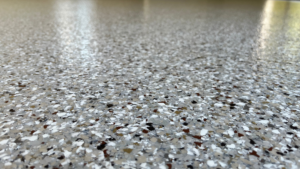
| Retail / grocery / showrooms | Appearance, foot traffic, overnight installs | Flake or quartz with polyaspartic topcoat, or polished concrete |
| Parking decks and ramps | Vehicles, water, freeze-thaw | Waterproofing traffic coatings, not interior floor epoxy |
| Fast-turnaround spaces | Overnight or weekend shutdown only | MMA or polyaspartic systems |
Heavy-duty plants have their own considerations; see our industrial flooring page.
Coating vs. Sealer vs. Polished Concrete
- Sealer — a thin protective treatment. Cheapest and fastest, but light protection and frequent reapplication.
- Coating — a bonded resin layer on top of the slab. Best for chemicals, spills, cleanability, and slip-resistant texture.
- Polished concrete — the slab itself is ground, densified, and polished. Very low maintenance, but it needs a sound slab and resists stains and chemicals less than a coating.
If your slab is in good shape, you don’t handle chemicals, and you want the lowest long-term maintenance, polished concrete is worth pricing alongside a coating. If you need chemical resistance, a sanitary surface, or to cover a beat-up slab, a coating usually wins.
Surface Prep: The Step That Decides Everything
A coating is only as good as its bond to the concrete. The International Concrete Repair Institute (ICRI) describes surface roughness on a scale called CSP (concrete surface profile), and each coating manufacturer specifies which CSP its system needs. Acid etching doesn’t reliably get there on commercial work. Mechanical prep does.
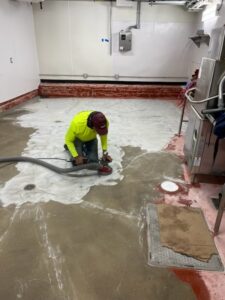
- Shot blasting propels steel shot at the slab to remove weak surface paste and contaminants, with a vacuum recovering shot and dust in the same pass. It’s fast on large open floors.
- Diamond grinding flattens high spots, removes thin coatings, and gets edges and smaller rooms a shot blaster can’t reach. Most jobs use both.
- Coating and adhesive removal comes first if there’s an old failed coating, tile, or mastic on the floor.
- Crack, spall, and joint repair gets done before the primer, with control joints filled or honored depending on the slab and the system.
See our concrete repair and surface preparation page.
Test for moisture before you pick a coating
Moisture coming up through the slab is one of the most common reasons coatings blister and peel. The two standard tests are ASTM F2170 (in-slab relative humidity probes) and ASTM F1869 (calcium chloride moisture vapor emission). Results get compared to the manufacturer’s limits. If the slab is over, you either wait, add a moisture mitigation primer, or choose a more moisture-tolerant system like urethane cement. More on that in how concrete moisture affects floor coatings and moisture mitigation for commercial flooring.
Installation Steps and Downtime
A typical commercial concrete floor coating goes in like this:
- Site walk and testing — moisture tests, slab assessment, and measurements.
- Prep — shot blasting, grinding, coating removal, and repairs. On a damaged slab, this is often the longest phase.
- Primer — seals the concrete and sets up the bond; moisture mitigation primer if testing calls for it.
- Build coat(s) — the body of the system, with broadcast flake or quartz if specified.
- Topcoat(s) — the wear, chemical, and UV layer.
- Cure — light foot traffic first, then wheeled traffic, then full chemical exposure.
Cure time is the big variable. One cost guide says epoxy can take up to a week to fully cure (HomeGuide), while another notes a traditional commercial epoxy system can take 3 to 7 days before full traffic and points to polyaspartic or MMA when a faster return to service is needed (EpoxyMatch). Cold slabs slow everything down, which matters in a New England winter. Go by the product data sheet before you roll equipment back in or start washdowns.
Ways to keep the business running:
- Phase the work so one area is coated while the rest stays open.
- Schedule nights and weekends, common for retail, grocery, and restaurants.
- Use fast-cure chemistry like polyaspartic or MMA when the window is tight.
How Much Does a Concrete Floor Coating Cost?
We won’t price your floor without seeing it, and you shouldn’t trust anyone who does. But published guides give useful budgeting ranges:
- General concrete coatings: $4 to $12 per square foot installed, with materials at about $1 to $6 and labor at about $3 to $6 per square foot (HomeGuide). Note that this guide is based mostly on garage floors.
- By chemistry: epoxy at $4 to $10, polyurea at $5 to $10, and polyaspartic at $5 to $12 per square foot installed (HomeGuide).
- Commercial systems: $3 to $12 per square foot installed. That breaks down to about $3 to $5 for thin-film epoxy, $5 to $8 for high-build warehouse and shop systems, $8 to $12+ for epoxy mortar, and $8 to $14 for urethane cement (EpoxyMatch).
- Sealers, for comparison: about $1 to $3 per square foot installed (HomeGuide). Floor Shield’s guide gives a range of $0.50 to $2.50 (Floor Shield).
Commonly overlooked line items, per the same commercial guide: removing old coatings, tile, or adhesive at $1 to $4 per square foot; moisture mitigation at $1.50 to $4 per square foot; cove base at $8 to $20 per linear foot; and a 10% to 25% premium for night, weekend, or phased work (EpoxyMatch). HomeGuide puts a moisture test at about $50 to $300 (HomeGuide).
Treat these as national ballparks, not Cape Cod or Boston pricing. For why the low bid often costs more, read our post on commercial floor coating cost.
What drives the price on your floor
- System and thickness — sealer vs. thin-film vs. high-build vs. mortar vs. urethane cement
- Square footage — mobilization costs about the same on small and large jobs
- Slab condition and moisture — old coatings, cracks, oil contamination, mitigation primer
- Details and schedule — cove base, drains, striping, nights, weekends, phasing
A quote far below the others usually means less prep, fewer mils, or no moisture testing. Ask every bidder for prep method, products, and total thickness in writing.
What About Garages and Residential Floors?
The same rules apply at home: prep mechanically, test for moisture, and skip the thin big-box kit if you want it to last. Topcoat does residential work too; see our residential epoxy flooring page.
Questions to Ask a Concrete Floor Coating Contractor
- Will you test for moisture, and how? Look for ASTM F2170 or F1869.
- How will you prep the slab? Shot blasting and/or diamond grinding, with dust control.
- What’s the full system? Products, number of coats, and total thickness in writing.
- What’s the warranty, and who backs it? Get it in writing.
- How will you work around my operation? Phasing, after-hours work, and return-to-service times.
- Can I see similar work? Ask for references or browse our case studies.
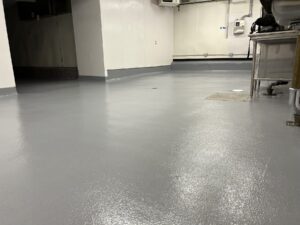
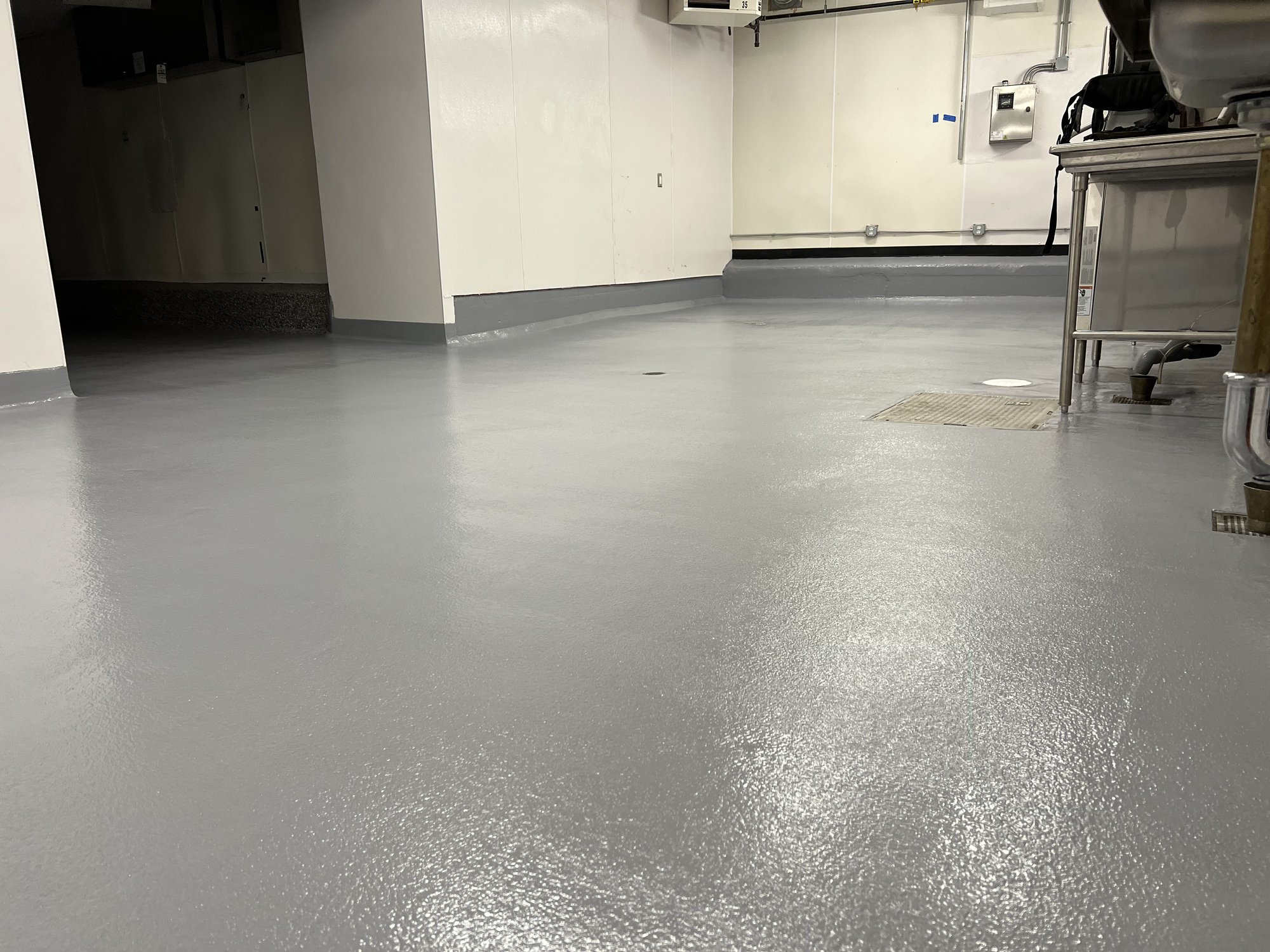
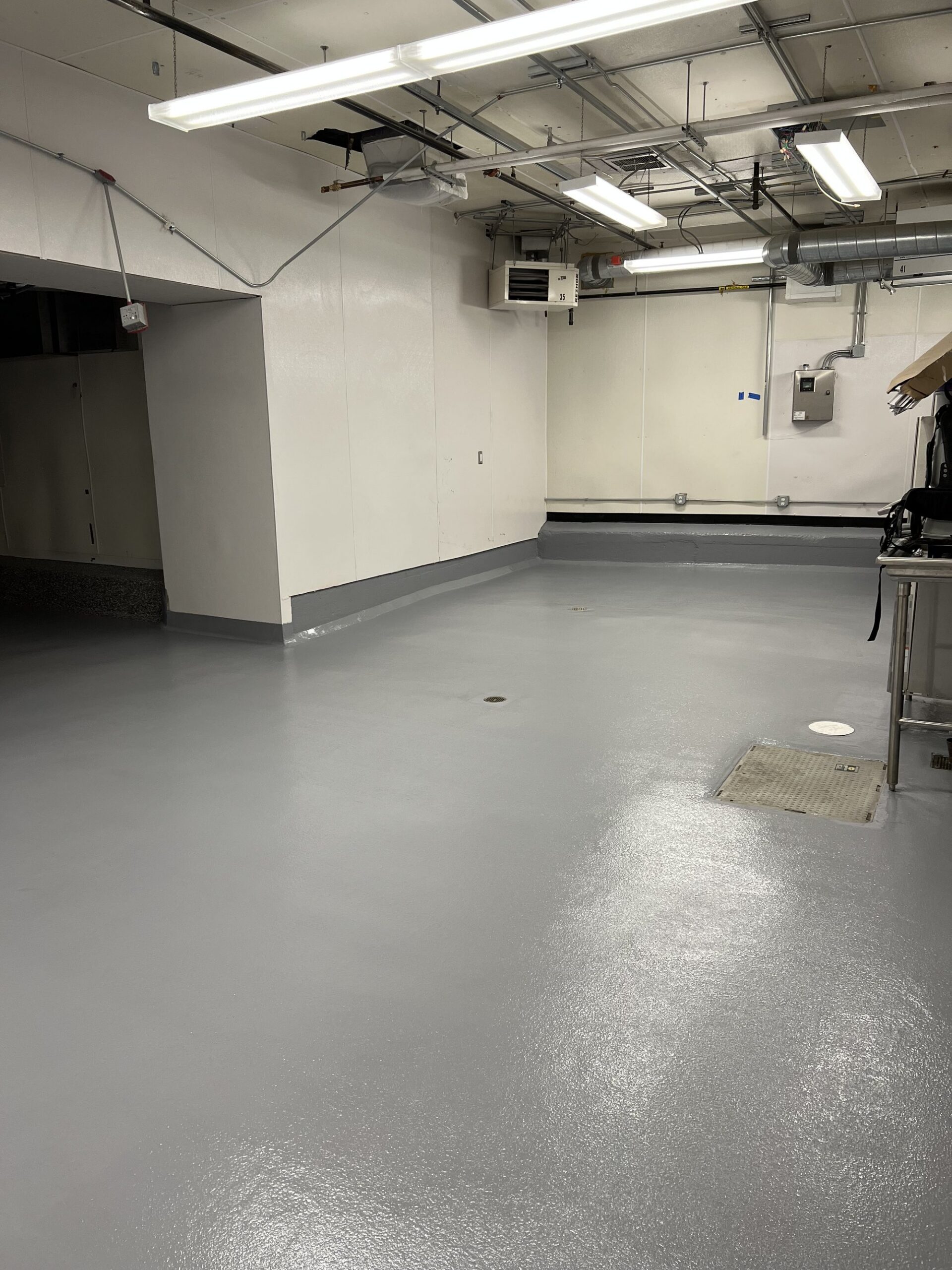
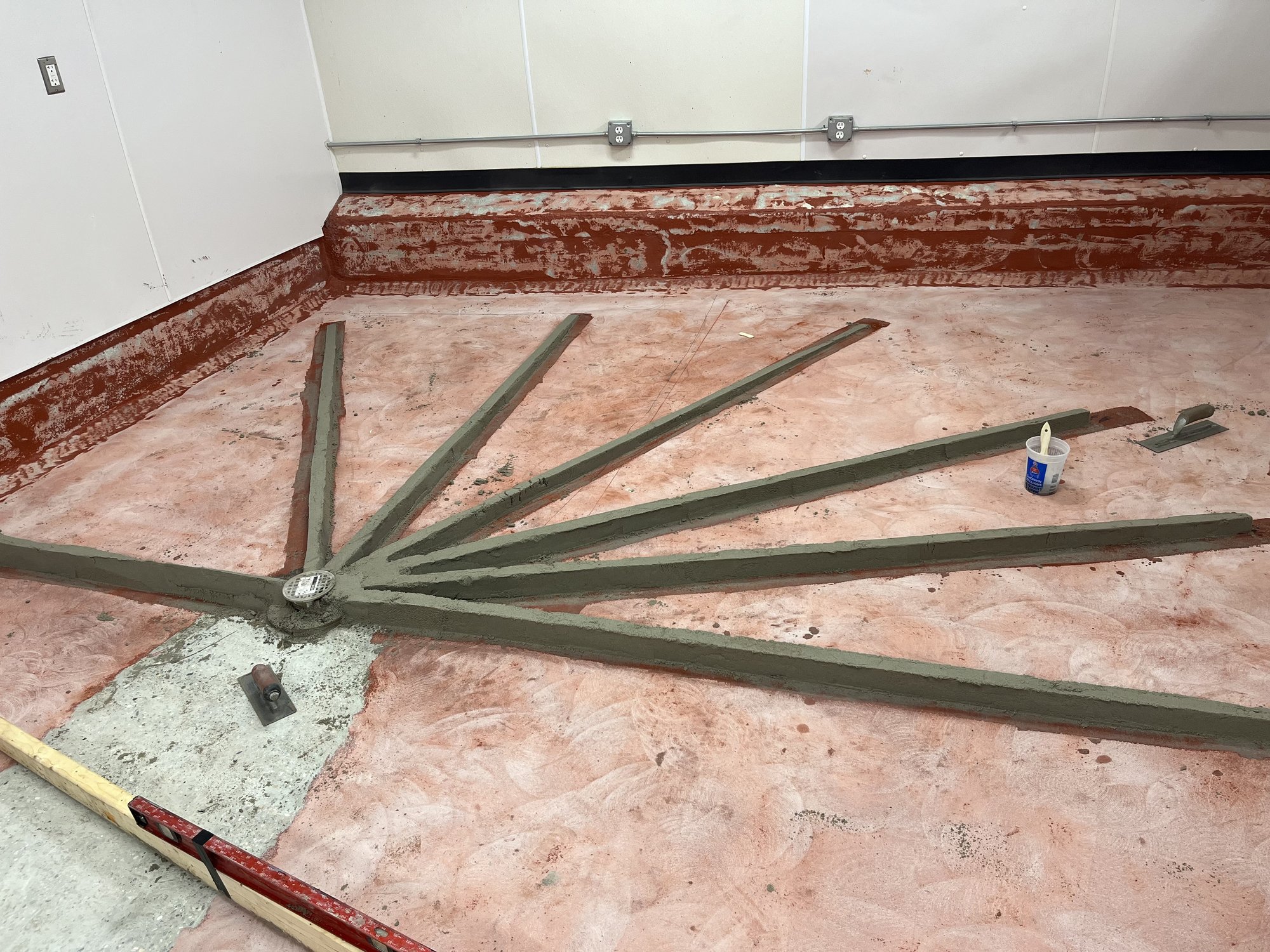
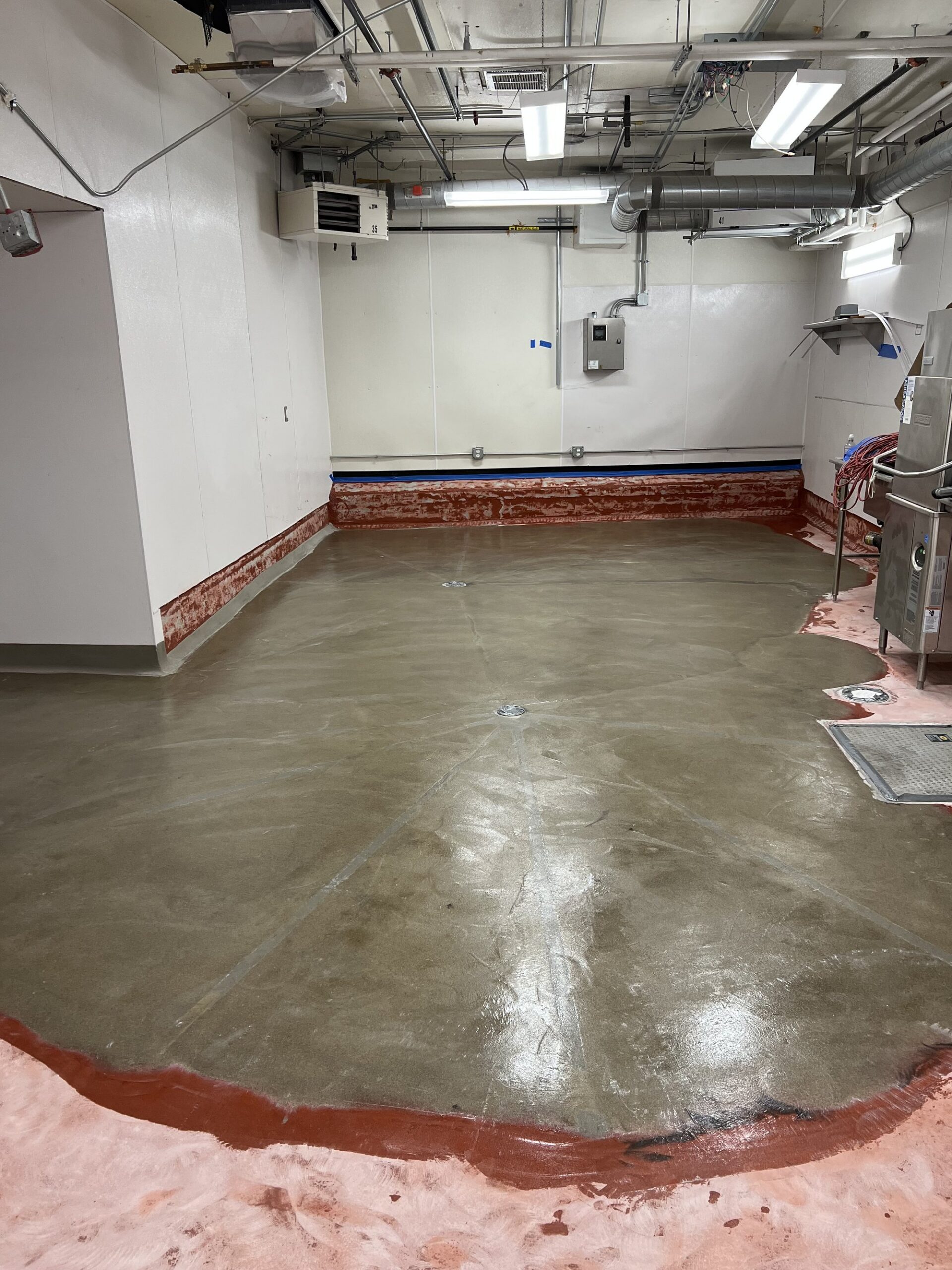
Commonwealth Kitchen, Boston (June 2023): about 660 sq ft in the baking room. We pitched and leveled the slab to the drains with urethane cement mortar to make way for new ovens, then finished the floor with a seamless urethane cement system, a topcoat, and an integral cove base.
Frequently Asked Questions
What is the best concrete floor coating?
It depends on the room. High-build epoxy with a urethane topcoat is the standard for most warehouses and shops. Polyaspartic is better when you need fast turnaround or UV stability. Urethane cement is the usual choice for hot washdown and food production.
How much does concrete floor coating cost per square foot?
Published cost guides put most installed coatings at roughly $3 to $12 per square foot, with urethane cement up to about $14 (EpoxyMatch, HomeGuide). Prep, moisture, square footage, and schedule set the real number.
How long does a concrete floor coating last?
It depends on traffic, chemicals, and maintenance. One guide cites 10 to 20 years for a properly specified commercial epoxy system, with a fresh topcoat every 5 to 7 years in heavy-traffic areas (EpoxyMatch).
Is a concrete floor coating better than a sealer?
A sealer is cheaper and fine for light-duty areas. A coating builds a real wear layer that stands up to traffic, chemicals, and spills.
Can you coat over an old coating or a damaged slab?
Sometimes. Well-bonded coatings can often be abraded and recoated; failed or peeling coatings come off first, and cracks get repaired.
Can the floor be coated without shutting down?
Often, yes, with phased work, nights and weekends, or fast-cure systems like polyaspartic or MMA.
Get a Quote for Your Concrete Floor Coating
Topcoat Services USA is a commercial and industrial flooring contractor based in Hyannis, MA, serving Cape Cod, Boston, and the rest of our service area across Massachusetts and New England. We handle the whole job, from shot blasting and surface prep to moisture mitigation, epoxy and urethane cement systems, self-leveling concrete, polished concrete, and roof coatings.
Tell us about your facility, square footage, and schedule. We’ll walk the floor, test the slab, and recommend the coating that fits. Request a quote from Topcoat.
With over 12 years of work experience in various fields, I am a versatile and adaptable manager at Topcoat Services USA LLC, a leading provider of polished concrete and epoxy flooring solutions. I have a strong background in logistics, having served as a logistics specialist in the United States Marine Corps for four and a half years. I also have a passion for culinary arts, and I worked as a sous chef at Crafted Hospitality, a renowned restaurant group, for two and a half years. At Topcoat Services USA LLC, I leverage my skills in epoxy flooring, project estimation, and logistics to deliver high-quality and cost-effective projects for our clients. I enjoy working with a diverse and collaborative team of professionals, and I am always eager to learn new techniques and technologies in the flooring industry. My mission is to create durable, beautiful, and sustainable floors that meet the needs and expectations of our customers.