Two contractors can quote the same square footage, offer similar schedules, and promise roughly the same finished appearance. On paper, their proposals may look almost identical.
In practice, the difference between them often comes down to the work you cannot see in the final photo: how the slab is evaluated, how the concrete is ground and refined, how cracks and joints are treated, what densification system is used, and whether the contractor has the right equipment to complete the project efficiently.
For warehouses, manufacturing plants, distribution centers, and other high-traffic commercial facilities, those details matter far more than how glossy a floor sample looks.
Start With the Condition of the Slab
Before discussing sheen levels, aggregate exposure, or the finished appearance, a contractor should understand the concrete they are working with.
The condition of an existing slab can vary significantly. It may be relatively new or decades old. It may have previous coatings, patches, cracks, contamination, soft areas, or repairs that will affect the polishing process.
For slabs drying from one side, probes are placed at 40% of the slab depth. This gives the contractor measurable information that can help guide decisions about preparation, repairs, and the overall flooring system.
This is especially important because polished concrete projects rarely begin with a completely untouched slab. Existing joint materials, patches, previous coatings, repairs, and other treatments can all affect how the concrete responds during grinding and polishing.
A good contractor should be able to explain what they found in the slab before recommending how the floor should be finished.
The Grinding Process Has a Major Impact on the Final Floor
Although the finished surface gets most of the attention, much of the quality of polished concrete is created during the grinding and refinement stages.
A commercial polishing system typically uses progressively finer diamond tooling. The early stages flatten and open the concrete surface. Each following stage refines the floor further and removes the scratch pattern created by the previous grit.
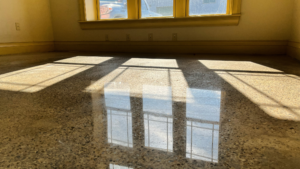
Skipping too far ahead in that progression can leave scratches or inconsistencies behind. They may not be obvious immediately, particularly in an empty building, but large open spaces, angled lighting, and ongoing traffic can make uneven refinement much more noticeable over time.
There is also no single polishing sequence that works for every project.
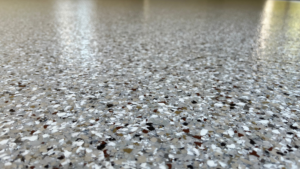
A hard, dense slab behaves differently from softer concrete. A cream finish requires a different approach than a floor with heavier aggregate exposure, and the desired level of sheen also affects the process.
Rather than simply asking whether a contractor uses a four-step, six-step, or nine-step system, ask what grinding and polishing progression they are recommending for your specific floor and why.
The answer should be based on the condition of the slab and the performance you expect from it.
Densifier Is One Part of the Polishing System
Densifiers are an important part of many polished concrete systems, but they are not a substitute for proper mechanical refinement.
Silicate-based densifiers react with compounds already present in the concrete and help create a harder, denser surface. Lithium, sodium, potassium, and other formulations are available, and contractors may use different systems depending on the slab and polishing process.
The more important question is how the densifier fits into the complete system.
A floor that receives limited grinding followed by densifier and a topical guard is very different from a floor that has been mechanically refined through multiple stages before the final treatment is applied.
Both may look good when the project is completed, but they are not necessarily designed to perform the same way.
In a facility exposed to forklifts, pallet jacks, carts, machinery, and continuous foot or vehicle traffic, the quality of the mechanical preparation and refinement matters.
Joint Treatment Matters in High-Traffic Facilities
Joints are another part of the floor that can easily be overlooked during the bidding process.
In a working warehouse or manufacturing environment, however, forklift and cart traffic repeatedly crosses those joints. If the edges are poorly protected or damaged, they can begin to break down under hard-wheel traffic.
Small chips can eventually turn into larger areas of spalling, creating additional repair work and affecting an otherwise sound floor.
Joint treatment should therefore be considered as part of the polishing plan from the beginning.
Depending on the condition and design of the floor, this may include semi-rigid epoxy or polyurea fillers, edge repairs, crack treatment, or other corrective work.
When reviewing a proposal, ask which joints will be filled or repaired, what materials will be used, and when that work will take place during the polishing process.
If the proposal does not address joints at all, it is worth asking why.
Equipment Capacity Affects Your Project Schedule
For large commercial flooring projects, equipment is not just a technical consideration. It directly affects scheduling and facility operations.
A contractor may understand polished concrete very well but still create delays if the equipment brought to the project is not appropriate for the amount of floor being completed.
Large-format, multi-head grinding equipment can cover greater areas while maintaining consistent pressure and refinement across the floor. That becomes especially important on projects involving tens of thousands of square feet.
If you are working around production schedules, shipping operations, tenants, or limited shutdown windows, the contractor needs a realistic plan for how the work will move through the facility.
Instead of asking only how many days the project will take, ask how that schedule was calculated.
What equipment will be used? How many machines and crew members will be on site? How will the project be phased? Can parts of the facility remain operational while other areas are being completed?
A well-supported production plan is more valuable than an aggressive completion date with little explanation behind it.
The Lowest Bid Can Become the Most Expensive Floor
Much of the work that determines the long-term performance of polished concrete is no longer visible once the floor is complete.
That creates opportunities to reduce time and cost during installation by cutting grinding stages, spending less time on edges, minimizing repairs, rushing joint treatment, or using a simpler polishing process.
The floor may still look excellent on the day it is handed over.
The differences often become clearer later, when traffic patterns begin to wear unevenly, joints deteriorate, scratches become more visible, or the floor requires more maintenance than expected.
For an operating facility, the cost of correcting those issues is not limited to another flooring invoice. It can also mean moving equipment, closing work areas, coordinating another contractor, scheduling nights or weekends, and disrupting normal operations.
That is why the lowest initial price is not always the lowest overall cost.
How Topcoat Approaches Polished Concrete
Topcoat’s approach to polished concrete is rooted in specialized Australian training and a mechanical polishing process focused on developing performance through the concrete itself rather than relying primarily on a temporary topical finish.
That reflects the same philosophy Topcoat brings to commercial flooring in general: the work underneath the finished surface needs to be done correctly if the floor is expected to perform over the long term.
With more than 30 years of trade experience across the team, Topcoat has worked in demanding commercial and institutional environments where appearance is important, but durability, scheduling, and operational downtime are equally important.
The company’s portfolio includes work associated with organizations such as Tufts, Dartmouth, JE Dunn, Toll Brothers, and other commercial clients throughout New England.
For Topcoat, polished concrete is not simply about producing a shiny floor. The goal is to recommend and install a system that fits the condition of the slab, the traffic it will experience, and the way the facility actually operates.
Questions to Ask Before Choosing a Polished Concrete Contractor
You do not need to become a concrete polishing expert to evaluate competing proposals. You do, however, want the contractor to explain how they plan to approach your floor.
Before signing a contract, consider asking:
- How will you evaluate the existing slab before work begins?
- What grinding and polishing progression are you recommending for this slab?
- How will you determine the appropriate aggregate exposure and level of sheen?
- What densification system will you use, and where does it fit into the polishing process?
- How will cracks, repairs, and joints be handled?
- What equipment will be brought to the site?
- What production rate is the schedule based on?
- How will the project be phased to minimize disruption to our operation?
- What ongoing maintenance will the finished floor require?
A polished concrete proposal should tell you more than what the finished floor is expected to look like. It should help you understand how the contractor plans to build the floor and why that process is appropriate for your facility.
If you are planning a polished concrete project for a warehouse, manufacturing facility, distribution center, commercial property, or institutional building, Topcoat Services can evaluate the existing slab, operating conditions, and project schedule before recommending the right approach.

With over 12 years of work experience in various fields, I am a versatile and adaptable manager at Topcoat Services USA LLC, a leading provider of polished concrete and epoxy flooring solutions. I have a strong background in logistics, having served as a logistics specialist in the United States Marine Corps for four and a half years. I also have a passion for culinary arts, and I worked as a sous chef at Crafted Hospitality, a renowned restaurant group, for two and a half years. At Topcoat Services USA LLC, I leverage my skills in epoxy flooring, project estimation, and logistics to deliver high-quality and cost-effective projects for our clients. I enjoy working with a diverse and collaborative team of professionals, and I am always eager to learn new techniques and technologies in the flooring industry. My mission is to create durable, beautiful, and sustainable floors that meet the needs and expectations of our customers.