Short answer: Choose urethane cement for wet, hot, washdown and food areas, such as commercial kitchens and food plants, where floors take hot water, cleaning and thermal shock. Choose epoxy for dry production floors, warehouses, showrooms and decorative finishes. Topcoat can install both in the same facility, matching each system to how each area is used.
Urethane Cement vs Epoxy at a Glance
Figures below are from Sherwin-Williams High Performance Flooring data sheets for the systems Topcoat installs most often for this comparison: Poly-Crete SLB (with TF Plus, or with Shop Floor and Armor Top (Resutile AT)) versus Resuflor Performance HTS and Resuflor Shop Floor SB. Resuflor Gard is a separate epoxy system and is not mixed into these columns.
| Urethane cement (Poly-Crete SLB) | Epoxy (Performance HTS / Shop Floor SB) | |
|---|---|---|
| Best uses | Wet, hot, washdown and food areas: commercial kitchens, food and beverage plants | Dry production floors, warehouses, shops and light industrial interiors; Shop Floor SB when a single-broadcast texture is preferred |
| Heat and thermal shock | SLB elevated-temperature test: no slip or flow at 158°F (MIL-D-3134), per the Poly-Crete SLB system sheet. Cementitious urethane is built for thermal shock from hot water and washdown. | Performance HTS and Shop Floor SB system sheets do not publish a °F heat or thermal-shock rating. Do not use Resuflor Gard’s 140–200°F band for these systems. |
| Slab moisture tolerance | Up to 99% RH (ASTM F-2170) and 20 lbs / 1,000 sq ft / 24 hr (ASTM F-1869) for the Poly-Crete family | Resuflor MPE and Resutile HTS 100 product sheets: below 75% relative internal concrete humidity (ASTM F-2170). Higher moisture may need a moisture-mitigating primer (confirm per job). |
| Chemical resistance | Strong resistance to many acids, alkalis, oils and solvents; some acids may bleach color. Match the topcoat (TF Plus or Shop Floor and Armor Top (Resutile AT)) in Sherwin-Williams’ chemical resistance guide for facility-specific chemicals. | Excellent protection against many chemicals; HTS 100 topcoat carries the detailed reagent chart. Match the exact topcoat in the chemical resistance guide for facility-specific chemicals. |
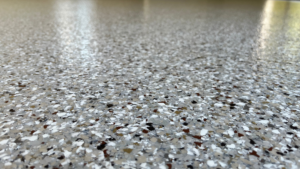
| Texture and look | About 3/16 in finished SLB with quartz broadcast; slip-resistant matte to semi-gloss depending on TF Plus or Shop Floor and Armor Top (Resutile AT) | Performance HTS: smooth solid-color epoxy with satin HTS 100 topcoat. Shop Floor SB: nominal 1/16 in single silica broadcast with satin HTS 100 seal. |
| Typical prep | Mechanically profile to about CSP 3–4; clean, sound concrete; keyed edges. Body is often self-priming; optional Poly-Crete TF primer where specified. | Performance HTS: about CSP 1–3. Shop Floor SB: CSP 3–5 abrasive blast. Both use Resuflor MPE in the build and Resutile HTS 100 as the seal coat. |
| Downtime / return to service | SLB body: light foot traffic from about 8 hours at 70°F. With TF Plus topcoat: light traffic about 12 hours; full service 3–5 days. With Shop Floor and Armor Top (Resutile AT): return to service about 24 hours; full chemical resistance 7 days. | After HTS 100 seal: light traffic about 24 hours at 75°F / 50% RH; full coating properties about 14 days. Colder or heavier traffic needs more time. |
When to Choose Urethane Cement
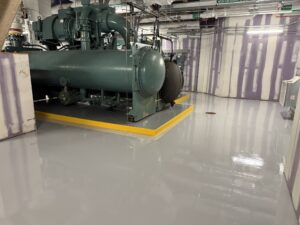
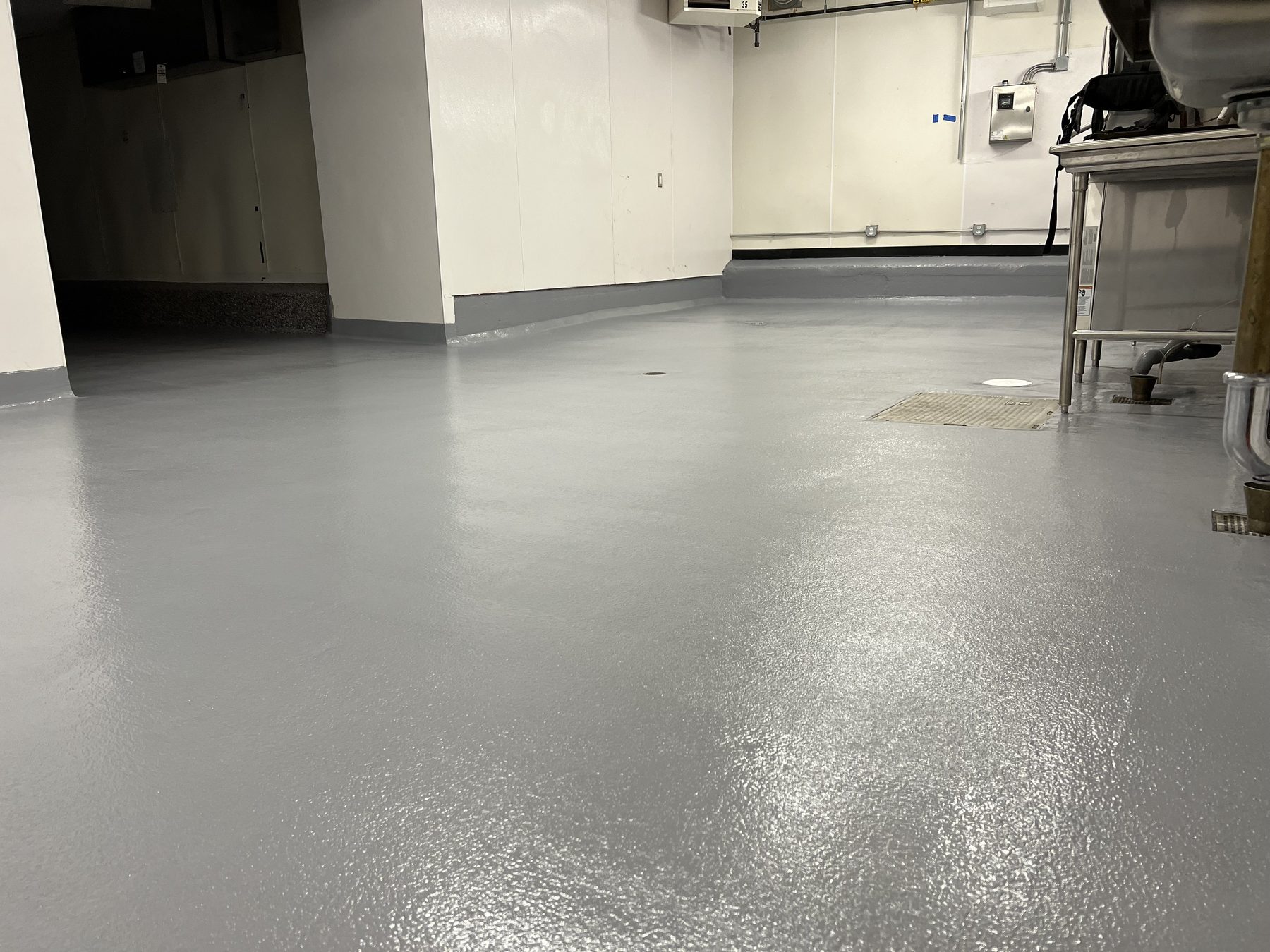
Urethane cement is built for floors that stay wet, see hot water or washdown, or handle food production. See our urethane cement flooring services.
Recent Topcoat urethane cement work includes Commonwealth Kitchen in Boston (Poly-Crete WR pitched to drains, Poly-Crete SLB and a Colorfast topcoat) and Essex North Shore Tech in Danvers (8,037 SF of Poly-Crete SLB with Armortop).
When to Choose Epoxy
Epoxy suits dry production floors, warehouses, showrooms and decorative finishes. For this comparison, Topcoat’s usual solid-color epoxy options are Resuflor Performance HTS and Resuflor Shop Floor SB. Read about our epoxy flooring systems and commercial epoxy flooring projects.
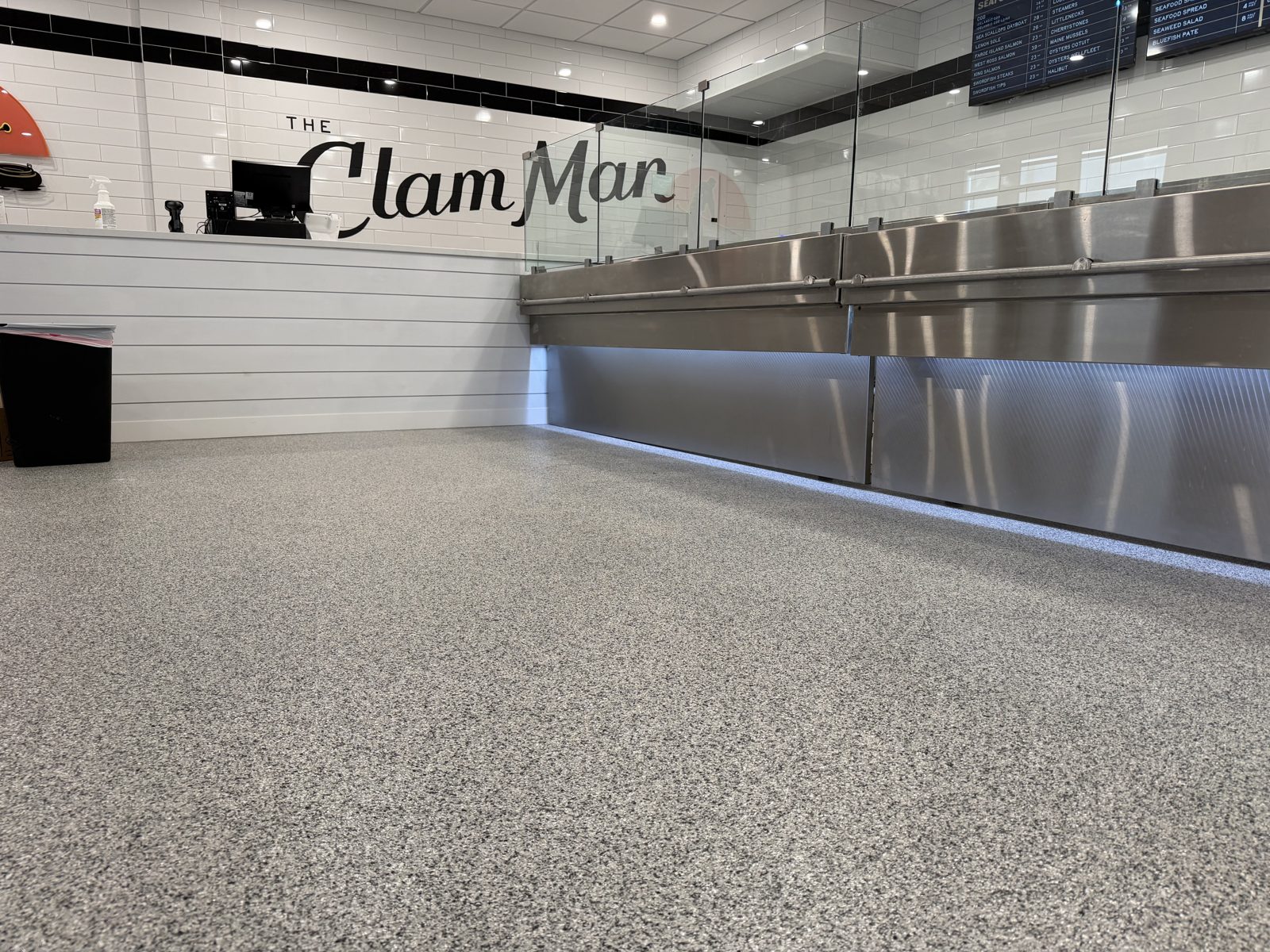
A related hybrid example (not a conventional solid-color epoxy): The Clam Man seafood market in Mashpee, MA, about 1,800 SF of Hybri-Flex EC flake, completed May 2026.
Can You Combine Them?
Yes. Topcoat can install urethane cement and epoxy in the same facility, matching each system to how each area is used—for example urethane cement in washdown or kitchen zones and epoxy in dry production or warehouse space.
Transition detailing depends on the slab, drainage and how each area is cleaned. We set that out in the proposal after looking at the floor.
Prep Decides Both
Whichever system you choose, the result depends on the slab underneath. Read about our concrete repair and surface preparation work and how concrete moisture affects floor coatings.
Frequently Asked Questions
Which is better for commercial kitchens, urethane cement or epoxy?
Urethane cement is generally the fit for wet, hot, washdown kitchen floors. At Commonwealth Kitchen in Boston, Topcoat installed Poly-Crete WR pitched to drains, Poly-Crete SLB and a Colorfast topcoat.
Which handles heat and thermal shock better?
Poly-Crete SLB is built for hot water and washdown: the SLB system sheet shows an elevated-temperature test of no slip or flow at 158°F (MIL-D-3134). Resuflor Performance HTS and Shop Floor SB system sheets do not publish a °F heat or thermal-shock rating, so for heat-heavy washdown areas urethane cement is the clearer fit.
Which handles moisture in the slab?
Poly-Crete systems are published up to 99% RH and 20 lbs MVER. Resuflor Performance HTS and Shop Floor SB builds that use MPE and Resutile HTS 100 call for below 75% internal RH unless a moisture-mitigating primer is specified. See how concrete moisture affects floor coatings.
How long is the cure time and downtime?
Poly-Crete SLB can take light foot traffic from about 8 hours at 70°F; with TF Plus full service is typically 3–5 days, and with Shop Floor and Armor Top (Resutile AT) return to service is about 24 hours with full chemical resistance in 7 days. Performance HTS and Shop Floor SB with HTS 100 are typically light traffic in about 24 hours at 75°F, with full coating properties in about 14 days.
Can urethane go over epoxy?
It depends on the existing coating. If the epoxy is well bonded and compatible, urethane cement can sometimes go over it after prep; if not, we remove it first. Send photos and we will tell you which path fits.
Get a Recommendation for Your Floor
Tell us how the space is used and cleaned, and we’ll recommend the system that fits. Request a urethane or epoxy flooring quote.
Areas we serve: Cape Cod · Framingham · Westford · Worcester · Boston · Providence · All service areas
With over 12 years of work experience in various fields, I am a versatile and adaptable manager at Topcoat Services USA LLC, a leading provider of polished concrete and epoxy flooring solutions. I have a strong background in logistics, having served as a logistics specialist in the United States Marine Corps for four and a half years. I also have a passion for culinary arts, and I worked as a sous chef at Crafted Hospitality, a renowned restaurant group, for two and a half years. At Topcoat Services USA LLC, I leverage my skills in epoxy flooring, project estimation, and logistics to deliver high-quality and cost-effective projects for our clients. I enjoy working with a diverse and collaborative team of professionals, and I am always eager to learn new techniques and technologies in the flooring industry. My mission is to create durable, beautiful, and sustainable floors that meet the needs and expectations of our customers.