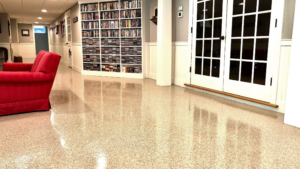
If you manage a warehouse, plant, kitchen, shop, or clinic, you’ve probably been told epoxy is “the” answer for your concrete floor. Sometimes it is. Sometimes a different resin system, or polished concrete, will serve you better. And almost every floor failure we get called to look at traces back to the same few causes: the wrong system for the room, skipped prep, or moisture nobody tested for.
This guide is written for facility managers and owners who have to make the call and live with the result. We’ll cover the main commercial epoxy flooring systems, which one fits which kind of facility, how surface prep works, how long you’ll be shut down, what drives cost, and what’s different about installing floors here in Massachusetts and New England.
What Is Commercial Epoxy Flooring?
Commercial epoxy flooring is a two-part resin system (resin plus hardener) applied over a prepared concrete slab. When the parts are mixed, they react and cure into a hard, seamless plastic layer that bonds to the concrete.
The word “commercial” matters. A garage kit from a big-box store is a thin, often water-based coating rolled over a lightly etched slab. A commercial or industrial epoxy floor is a system: mechanical surface prep, a penetrating primer, one or more body coats built to a specified thickness, often a broadcast aggregate for texture, and a topcoat chosen for wear, chemicals, or UV. Thickness is usually measured in mils (thousandths of an inch) for coatings and in fractions of an inch for mortars.
What you get from a properly built system:
- Seamless surface with no grout lines to trap dirt, bacteria, or liquids
- Chemical and stain resistance against oils, fuels, cleaners, and many process chemicals
- Impact and abrasion resistance for forklifts, pallet jacks, carts, and foot traffic
- Light reflectivity that brightens work areas
- Easy cleaning — important for food, healthcare, and anything inspected
Types of Commercial Epoxy Flooring Systems
Most competitor pages list product names. Here’s what the categories actually mean and when each one makes sense.
Thin-film and high-build roller coatings
Thin-film epoxy (roughly 10–20 mils) is the entry point: dust-proofing and light protection for storage rooms, mechanical rooms, and back offices. High-build, 100%-solids epoxy (roughly 30–60 mils) is the workhorse for warehouses, distribution, and auto shops. More thickness means more material and labor, but much better tolerance for traffic and impact.
Self-leveling epoxy
A pourable, self-smoothing epoxy (often 1/16″ to 1/8″) that produces a flat, glossy, monolithic surface. Good for clean manufacturing, labs, electronics, and showrooms. It’s smooth, so it can be slippery when wet unless a texture is added.
Broadcast systems (quartz or flake)
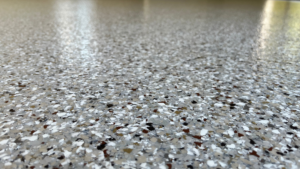
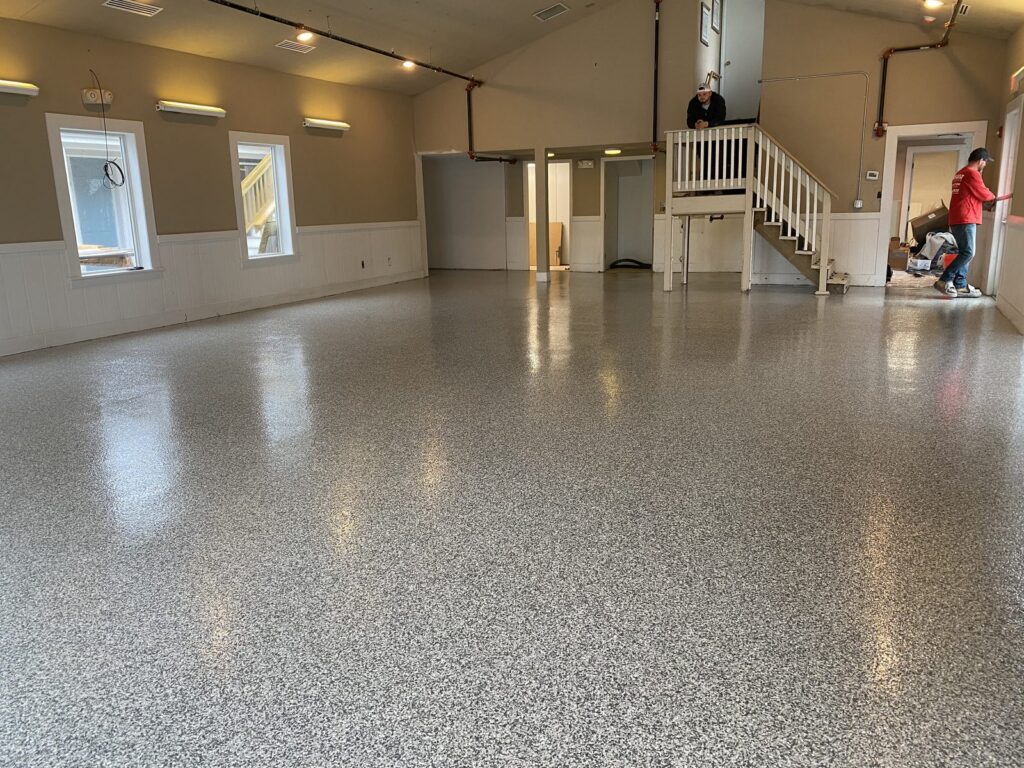
Colored quartz or vinyl flake is broadcast into wet epoxy, then locked in with clear topcoats. You get built-in slip resistance, hidden wear, and a decorative look. Quartz is common in restrooms, locker rooms, healthcare corridors, and kitchens; flake shows up in retail, lobbies, and showrooms.
Epoxy mortar (troweled) systems
A heavy mix of epoxy and graded aggregate troweled down at 1/4″ or more. This is the system for heavy impact, rough slabs, and areas that need slope-to-drain. It can also rebuild deteriorated concrete as part of the floor.
Urethane cement — when epoxy isn’t the right answer
Urethane cement (urethane mortar) is not epoxy, but it belongs in this conversation. It handles thermal shock from hot washdown, steam cleaning, and freezer doors far better than epoxy, and it tolerates more slab moisture. For commercial kitchens, breweries, dairy, and food and beverage plants, it’s often the right base system. See our urethane cement flooring page for details.
Moisture mitigation primers
When a slab emits too much moisture vapor, a standard epoxy will blister and debond. Moisture vapor mitigation (MVM) epoxy primers are formulated to block that vapor and give the rest of the system a sound base. Whether you need one is a testing question, not a guess (more on that below).
Topcoats: urethane, polyaspartic, and others
The topcoat is the wear layer. Standard epoxy yellows (ambers) under UV and scratches more easily, so many systems finish with:
- Aliphatic urethane — better abrasion and UV resistance, chemical-resistant grades available
- Polyaspartic — very fast cure and UV-stable, good for fast turnarounds and sunlit areas
- Chemical-resistant novolac epoxy — for secondary containment and aggressive acids or solvents
Which System Fits Which Facility?
| Facility | Typical demands | Systems we’d usually look at |
|---|---|---|
| Warehouse / distribution | Forklifts, pallet jacks, striping, dust | High-build epoxy, urethane topcoat, line striping |
| Manufacturing | Impact, oils, chemicals, rough slabs | Epoxy mortar or self-leveling, chemical-resistant topcoat |
| Commercial kitchens / food & beverage | Hot water, steam, grease, sanitation, drains | Urethane cement with integral cove; quartz broadcast in dry areas |
| Healthcare / labs / vet clinics | Cleanability, disinfectants, seamless cove | Quartz broadcast or self-leveling epoxy with cove base |
| Retail / grocery | Appearance, foot traffic, overnight installs | Flake or quartz with polyaspartic, or polished concrete |
| Auto shops / fleet / public safety | Hot tires, fuels, brake fluid, road salt | High-build epoxy with chemical-resistant urethane, broadcast texture |
| Schools / universities | Durability, summer-break schedules | Broadcast epoxy or polished concrete |
If you want to see how this plays out by sector, our industries page covers each one, along with dedicated pages for commercial kitchen flooring, food and beverage manufacturing flooring, retail and grocery flooring, and school and university flooring.
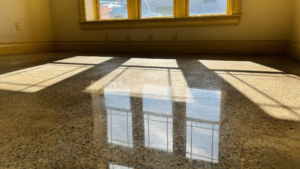
One honest note: polished concrete is sometimes the better buy. If your slab is sound and dry, you don’t need chemical resistance, and you want the lowest long-term maintenance, it’s worth comparing.
Surface Prep: Where Floors Succeed or Fail
The coating is only as good as its bond to the concrete. Industry guidance from the International Concrete Repair Institute (ICRI) describes surface profiles on a scale called CSP (concrete surface profile); the coating manufacturer specifies which CSP their system needs. Acid etching doesn’t reliably get you there on commercial work. Mechanical prep does.
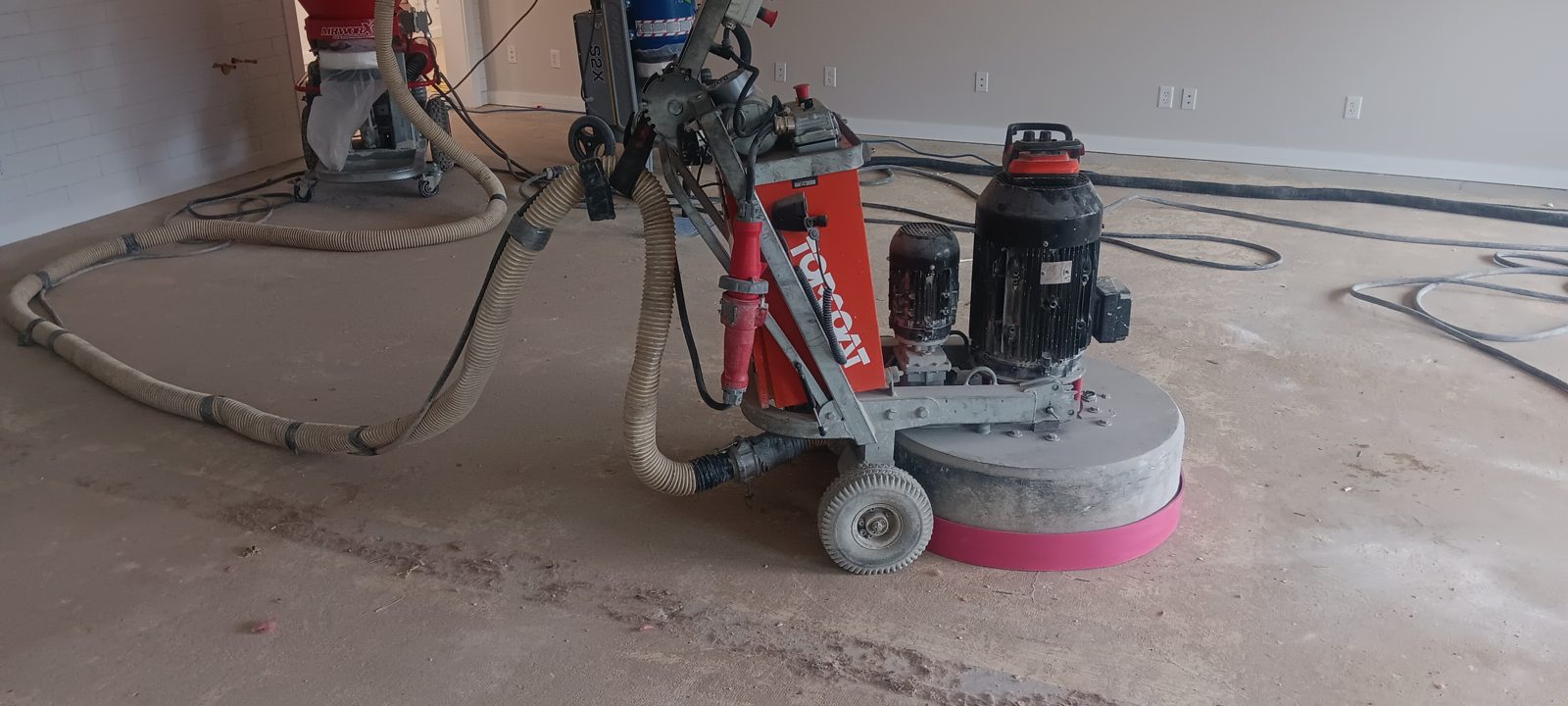
Shot blasting concrete
Shot blasting propels steel shot at the slab, removing laitance, contaminants, and weak surface paste, and leaves a uniform profile. A vacuum recovers the shot and dust in the same pass. It’s fast on large open areas, which makes it the go-to for warehouses and plants.
Diamond grinding
Planetary grinders with diamond tooling flatten high spots, remove thin coatings, and prep edges and smaller rooms where a shot blaster can’t reach. Most jobs use both.
Coating removal, crack and joint repair
Old failed coatings, mastic, and tile adhesive come off first. Cracks and spalls are repaired, and control joints are addressed (filled or honored depending on the slab and the system). Our concrete repair and surface preparation page explains the options.
Moisture testing
Before specifying a system, the slab should be tested. The two common ASTM methods are ASTM F2170 (in-situ relative humidity probes) and ASTM F1869 (calcium chloride moisture vapor emission). Results are compared to the manufacturer’s limits. If the slab is over, you either wait, use a moisture mitigation primer, or choose a more moisture-tolerant system like urethane cement.
Installation Timeline and Downtime
Downtime is often the deciding factor for businesses. Here’s how a typical install sequences:
- Site walk and testing — moisture testing, slab assessment, measurements.
- Prep — shot blasting, grinding, repairs. Often the longest phase on a damaged slab.
- Primer — penetrates and seals the concrete; MVM primer if needed.
- Body coat(s) — the build layer; broadcast aggregate if specified.
- Topcoat(s) — wear and chemical protection.
- Cure — light foot traffic, then full service.
Cure time depends heavily on chemistry and temperature. Published industry guidance puts standard 100%-solids epoxy at roughly 12–72 hours between coats and to return to service depending on temperature, while polyaspartic coatings can cure in a few hours (Terrapin Construction Group). Full chemical resistance typically takes longer than walk-on time, so check the product data sheet before you roll equipment back in or start washdowns.
Ways to minimize disruption:
- Phasing — do the building in sections so operations keep running.
- Nights and weekends — common for retail, grocery, and restaurants.
- Fast-cure chemistry — polyaspartic topcoats or fast-set primers when the schedule is tight.
- Planned shutdowns — schedule around holiday breaks, school summers, or retooling.
Expect to clear the area completely, shut off or protect HVAC intakes during application, and plan for odor control on some systems (low-odor options exist for occupied buildings).
How Much Does Commercial Epoxy Flooring Cost?
We won’t quote a price without seeing your floor, and you shouldn’t trust anyone who does. But published 2026 guides give a useful budgeting range:
- One 2026 guide puts commercial epoxy flooring at $3 to $12 per square foot installed: about $3–$5 for thin-film, $5–$8 for high-build warehouse and shop systems, and $8–$12+ for epoxy mortar, with urethane cement around $8–$14 (EpoxyMatch).
- Another contractor guide puts most commercial systems at $4 to $10 per square foot installed, noting heavy urethane cement and mortar builds can exceed that (Precision Epoxy).
- A third (Southeast pricing) gives $3 to $15 per square foot, and notes that per-square-foot pricing drops as square footage rises because mobilization and setup are largely fixed costs (AI Coatings).
Treat these as national ballparks. Labor and logistics in Massachusetts and Cape Cod differ from other markets, and your slab is the biggest variable.
What drives epoxy flooring cost per square foot
- System type and thickness — thin-film vs. high-build vs. mortar vs. urethane cement.
- Square footage — small jobs carry the same mobilization as big ones.
- Slab condition — coating removal, cracks, spalls, oil contamination, and leveling.
- Moisture — a mitigation primer adds material and a step.
- Details — cove base, drains, slope-to-drain, line striping, logos, and transitions.
- Schedule — night, weekend, or phased work often carries a premium.
- Access — occupied buildings, multiple floors, or tight working windows.
A quote far below the others usually means something is missing: less prep, fewer mils, or no moisture testing. Ask every bidder to list prep method, system, and total thickness so you’re comparing the same floor.
Maintenance and Lifespan
A well-installed commercial system can last many years, but service life depends on traffic, chemicals, and care. One published guide cites roughly 10–20 years for commercial epoxy (EpoxyMatch); in heavy industrial use, plan on recoating the topcoat sooner.
Practical maintenance:
- Sweep or dust-mop daily — grit is what wears topcoats.
- Auto-scrub with a neutral pH cleaner and soft pads; avoid harsh acids unless the system is rated for them.
- Clean spills promptly, especially solvents and hot fluids.
- Use walk-off mats at entries to keep sand and salt off the floor.
- Recoat the topcoat when wear paths appear, before the base layers wear through. A recoat is far cheaper than a full replacement.
New England Considerations
Installing floors here is not the same as installing them in Florida.
- Cold-weather cure. Epoxy cures slowly in cold slabs and air. Many products need minimum substrate temperatures and a margin above dew point to avoid blushing and adhesion problems. In unheated warehouses, garages, and new buildings in winter, temporary heat or a cold-tolerant chemistry may be needed.
- Moisture. Slabs on grade without vapor barriers, older mill buildings, and coastal sites can push serious moisture. Testing is not optional.
- Road salt and snowmelt. Fleet bays, fire stations, parking structures, and loading docks see chloride-laden slush all winter. Choose chemical-resistant topcoats and adequate texture. For parking decks and ramps, a traffic coating system is usually the better fit.
- Freeze-thaw. Exterior and semi-exposed concrete needs systems designed for movement and thermal cycling; standard interior epoxy is not one of them.
- UV near glass. Storefronts and showrooms with big windows need a UV-stable topcoat to avoid ambering.
Topcoat works across Cape Cod, Boston, Worcester, Providence, and the rest of our service area for epoxy flooring in Massachusetts and New England.
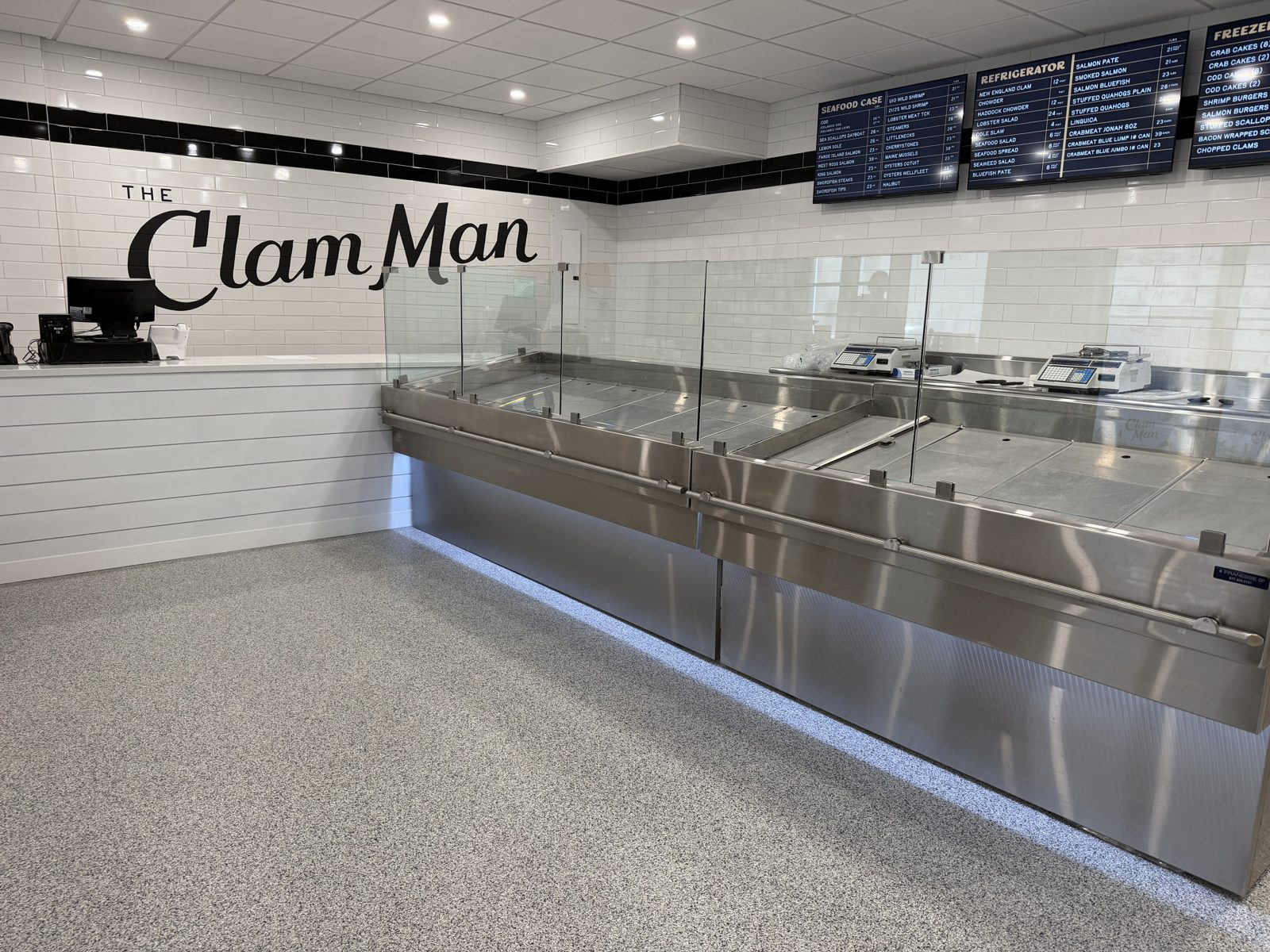
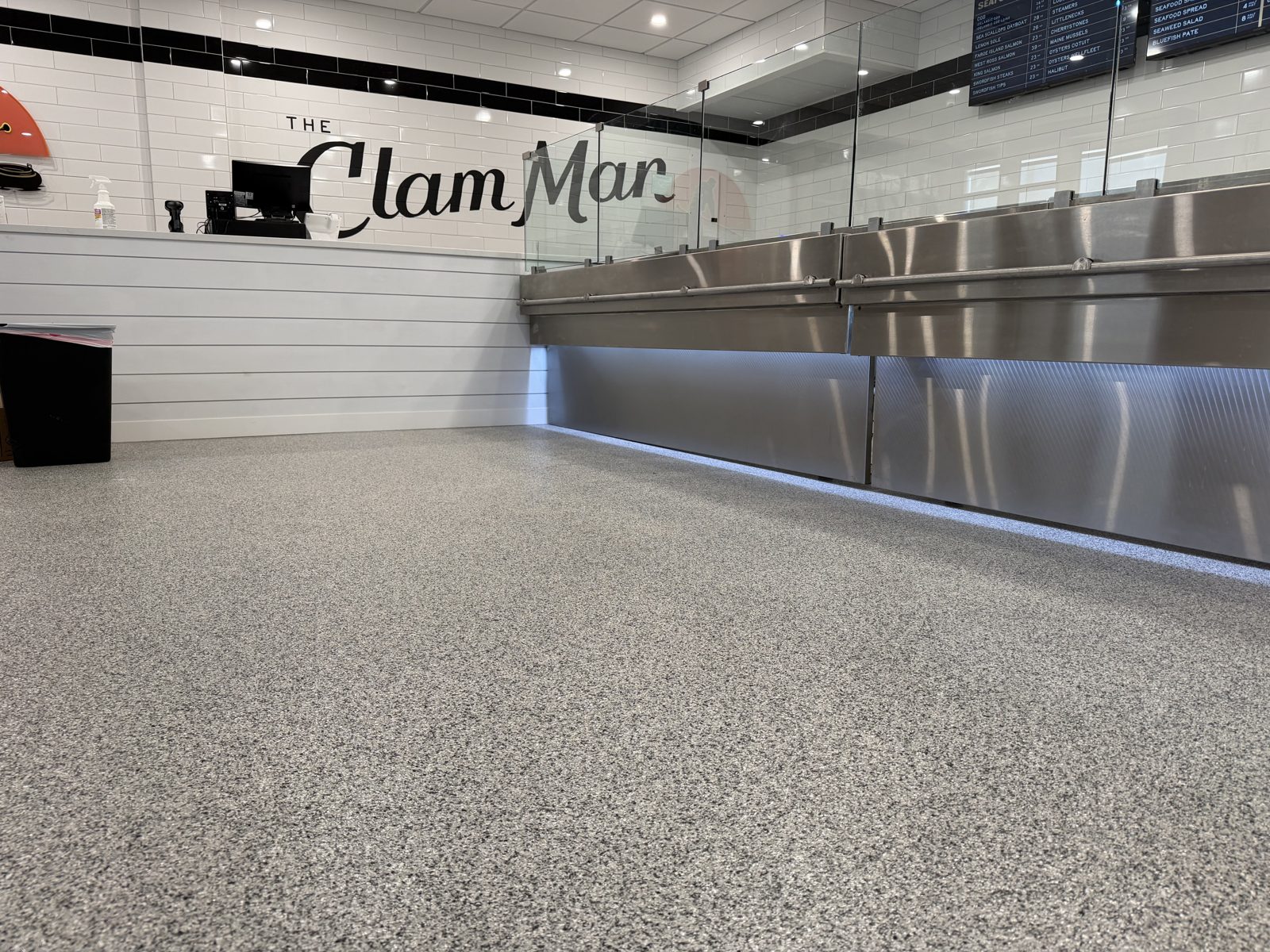
Project Spotlight: The Clam Man, Mashpee, MA
Topcoat installed 1,800 square feet of Hybri-Flex EC at The Clam Man seafood market in Mashpee, MA, completed in May 2026. The gray flake floor runs through the counter area, beneath the stainless steel seafood display cases and up to the white tile and shiplap walls.
How to Choose a Commercial Epoxy Flooring Contractor
Ask these before you sign:
- Do you test for moisture, and which method? Look for ASTM F2170 or F1869, not a guess.
- How will you prep the slab? Shot blasting and/or diamond grinding, with dust control.
- What’s the full system? Products, number of coats, and total thickness in writing.
- Who makes the materials, and do you follow their specs? Ask for product data sheets.
- What’s the warranty, and what does it cover? Get it in writing and know who backs it.
- Can you work around my operations? Phasing, nights, weekends, return-to-service times.
- Can I see similar work? Ask for references or case studies in your industry. You can browse ours on our case studies page.
Frequently Asked Questions
Is epoxy flooring good for commercial use?
Yes, for most dry and moderate-duty commercial spaces: warehouses, shops, retail, healthcare, and light manufacturing. For areas with hot water, steam, or thermal shock, urethane cement is usually the better choice.
What does commercial epoxy flooring cost?
Published 2026 guides put most commercial systems between roughly $3 and $12 per square foot installed, with heavy mortar and urethane cement systems higher. Your slab condition, moisture, square footage, and schedule set the real number, which is why a site visit matters.
Is epoxy flooring safe for commercial kitchens?
Epoxy works in dry kitchen areas and storage, but hot-line and dish areas with hot washdown are hard on it. Most commercial kitchens are better served by urethane cement with an integral cove base and a textured finish for slip resistance.
How long does it take to install commercial epoxy flooring?
It depends on square footage, prep, and chemistry. Each coat of standard epoxy needs time to cure — typically 12 to 72 hours depending on temperature — while fast-cure polyaspartic topcoats can shorten the schedule. Phased and overnight installs can keep a business running.
What are the maintenance requirements for commercial epoxy flooring?
Daily sweeping, regular auto-scrubbing with a neutral cleaner, prompt spill cleanup, entry mats, and periodic topcoat recoats when wear paths appear.
Why choose commercial epoxy flooring over other options?
Seamless, cleanable, chemical-resistant, and bright, with a wide range of textures and colors. It’s not always the winner, though; polished concrete or urethane cement can be the smarter buy depending on the space.
Get a Quote for Commercial Epoxy Flooring
Topcoat Services USA is a commercial and industrial flooring contractor based in Hyannis, MA, serving Cape Cod, Massachusetts, and New England. We handle the whole job — shot blasting and surface prep, moisture mitigation, epoxy flooring, urethane cement, self-leveling concrete, polished concrete, and roof coatings.
Tell us about your facility, square footage, and schedule, and we’ll walk the floor, test the slab, and recommend the system that fits. Request a quote from Topcoat.
With over 12 years of work experience in various fields, I am a versatile and adaptable manager at Topcoat Services USA LLC, a leading provider of polished concrete and epoxy flooring solutions. I have a strong background in logistics, having served as a logistics specialist in the United States Marine Corps for four and a half years. I also have a passion for culinary arts, and I worked as a sous chef at Crafted Hospitality, a renowned restaurant group, for two and a half years. At Topcoat Services USA LLC, I leverage my skills in epoxy flooring, project estimation, and logistics to deliver high-quality and cost-effective projects for our clients. I enjoy working with a diverse and collaborative team of professionals, and I am always eager to learn new techniques and technologies in the flooring industry. My mission is to create durable, beautiful, and sustainable floors that meet the needs and expectations of our customers.