Commercial floor coatings depend on what happens on the floor, not on which product a contractor prefers to sell. The right system for your facility comes down to fit, not preference. Epoxy handles heavy static loads and chemicals. Urethane cement survives thermal shock and washdowns. Polyaspartic cures fast and resists UV. Polished concrete is low-maintenance for lighter-duty spaces. Match the system to the environment, and it lasts 15 years. Guess, and you can be recoating in three.
Most of what you will find online about floor coatings is written for a homeowner doing their garage on a Saturday. That’s a different job with different stakes. A garage floor that peels is an annoyance. A warehouse floor that fails shuts down a loading dock, or fails a health inspection, or forces a weekend tear-out around your production schedule.
Commercial buyers aren’t choosing a color. They are specifying a system that has to hold up under forklifts, hot wash-down water, dropped tools, chemical spills, and traffic that never really stops. Here’s how the four systems we install actually compare and how to tell which one belongs in your building.
The four commercial floor coatings and what each one is actually for
Epoxy. The workhorse. A two-part resin that cures into a hard, seamless, chemical-resistant surface bonded into the concrete. A professional 100% solids epoxy is built at roughly 10 to 20 mils, and heavy-duty self-leveling systems go thicker still, in the 35 to 40 mil range for abusive environments. Epoxy is tough and cost-effective. Its two weak points: it can amber and yellow under direct UV without a UV-stable topcoat, and it cures slowly, needing 24 to 72 hours between coats and up to 7 to 10 days for full chemical resistance.
Urethane cement. The system for punishing environments. It’s applied thick over a heavily profiled slab and shrugs off thermal shock, the kind you get when a commercial kitchen or food plant hits a hot floor with cold wash-down water. If your facility deals with steam, boiling water, or wide temperature swings, this is usually the correct call, and using anything cheaper is how floors crack and delaminate fast.
Polyaspartic. The fast one. A polyurea-based coating that cures in hours instead of days so a space can be back in service the next morning. It holds its color under UV and resists abrasion and chemicals well and shines as a topcoat over an epoxy base. When downtime is the real cost, it’s the answer. The catch is that it demands an experienced crew: it cures so fast that a rushed or poorly timed install traps bubbles and flaws. Fast products don’t mean fast corners.
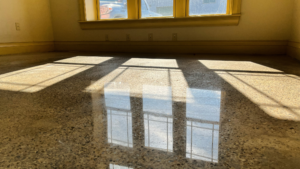
Polished concrete. Not a coating at all, but often the right answer. The existing slab is ground and densified into a hard, low-dust, low-maintenance surface with an industrial sheen. It runs cheaper per square foot and needs little upkeep, which suits showrooms, retail, and light-duty commercial space. It doesn’t give you the chemical resistance or the custom colour and texture of a resinous system, so it’s the wrong pick for a floor that takes real chemical or impact abuse.
Quick comparison
| System | Best for | Cure to service | UV stability | Relative cost | Typical lifespan |
|---|---|---|---|---|---|
| Epoxy (100% solids) | Warehouses, manufacturing, static loads, chemical areas | 24–72 hrs between coats; 7–10 days full cure | Ambers without UV topcoat | $ | 10–15+ yrs |
| Urethane cement | Food & beverage, kitchens, thermal shock, washdown | 1–2 days | Good | $$$ | 15–20 yrs |
| Polyaspartic | Fast turnaround, UV exposure, topcoats | Same day / next morning | Excellent | $$ | 10–15+ yrs |
| Polished concrete | Showrooms, retail, light-duty, low maintenance | 2–3 days | N/A | $ | 10–20+ yrs |
Cost is relative and depends heavily on slab condition. A real number needs a site visit.
Match the system to the environment
- Warehouse and distribution: epoxy or an epoxy base with a polyaspartic topcoat, built thick enough for forklift traffic.
- Food and beverage, commercial kitchens: urethane cement for thermal shock, chemical exposure, and USDA-friendly cleanability.
- Healthcare and clean environments: monolithic epoxy for sanitation and easy cleaning.
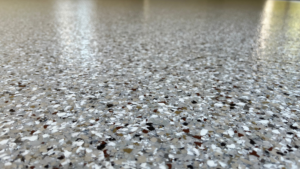
- Showrooms, retail, and offices: polished concrete or a decorative flake epoxy, where appearance and low maintenance matter more than chemical resistance.
- Anything with UV exposure or a next-day reopening requirement: a polyaspartic topcoat.
The decision most people get wrong
Here’s the part the product-comparison articles skip. The system matters less than the slab it goes on and the crew that installs it.
The single most common reason a commercial floor coatings fail is moisture moving up through the concrete, not a bad product choice. That’s why a legitimate installer tests the slab before quoting, using standards like ASTM F2170 or F1869, and why prep work (diamond grinding or shot blasting to the right profile) is the majority of the labour. The coating is only as good as the bond underneath it. Two contractors can quote “the same” epoxy and deliver floors that last 2 years and 15 years because one skipped the moisture test and the grind.
So the right question isn’t “epoxy or polyaspartic”. It’s “which system, at what thickness, over what prep, for the way this floor actually gets used.” That’s a spec, not a product off a shelf.
Frequently asked questions about commercial floor coatings
What is the difference between epoxy, polyaspartic, urethane cement, and polished concrete? Epoxy is a hard, chemical-resistant resin coating. Polyaspartic is a fast-curing, UV-stable coating often used as a topcoat. Urethane cement is a thick, thermal-shock-resistant system for kitchens and food plants. Polished concrete is a ground-and-densified finish on the existing slab, not a coating.
Which floor coating is best for a warehouse? Usually a professional-grade epoxy, often with a polyaspartic topcoat, built thick enough to handle forklift traffic and point loads.
Is polyaspartic better than epoxy? Neither is “better”. Polyaspartic cures faster and holds color under UV; epoxy is a tougher, more economical base for heavy static loads. The strongest systems often use both epoxy as the base and polyaspartic on top.
How thick should a commercial epoxy floor be? Professional 100% solids systems typically run 10 to 20 mils, with heavy-duty self-leveling builds at 35 to 40 mils for abusive environments. Thin, big-box “epoxy paint” is often only 1 to 2 mils and isn’t built for commercial use.
How long does a commercial floor coatings last? Properly specified and installed, 10 to 20 years depending on the system and the traffic. Installed over an untested or poorly prepped slab, it can start failing within a few years.
Not sure which commercial floor coatings your facility actually needs? A short on-site assessment tells you what your slab requires before anyone quotes a number. Reach out for an assessment.

With over 12 years of work experience in various fields, I am a versatile and adaptable manager at Topcoat Services USA LLC, a leading provider of polished concrete and epoxy flooring solutions. I have a strong background in logistics, having served as a logistics specialist in the United States Marine Corps for four and a half years. I also have a passion for culinary arts, and I worked as a sous chef at Crafted Hospitality, a renowned restaurant group, for two and a half years. At Topcoat Services USA LLC, I leverage my skills in epoxy flooring, project estimation, and logistics to deliver high-quality and cost-effective projects for our clients. I enjoy working with a diverse and collaborative team of professionals, and I am always eager to learn new techniques and technologies in the flooring industry. My mission is to create durable, beautiful, and sustainable floors that meet the needs and expectations of our customers.