Search “epoxy flooring cost” and you’ll get a dozen pages that all say about the same thing: $3 to $12 a square foot. That isn’t wrong, but it isn’t much help. Most of those pages are built on garage jobs, and they don’t say how thick the floor is or what’s included.
If you manage a warehouse, plant, kitchen, school, or shop, you need something better to budget with. This guide shows what real public bids paid for specific epoxy systems, breaks a commercial quote into the pieces that drive the number, and walks through a sample budget so you can see how removal, moisture, and job size stack up.
One thing up front: we don’t price floors we haven’t seen, and every figure below is a published number from the source linked next to it. None of them are Topcoat prices.
The Short Answer: Published Epoxy Flooring Cost Ranges
Here’s what the most-cited 2026 sources say, side by side:
| Source | What it covers | Installed cost per sq ft |
|---|---|---|
| Angi | Mostly residential garages and concrete surfaces | $2 – $12 |
| HomeGuide | Residential (garage, basement, patio) | $4 – $10 |
| Peckham Coatings | Commercial, Western U.S. contractor | $3 – $14 (most $5 – $9) |
| City of Tulsa bid, Oct. 2024 | Four specified commercial systems, public bid | $7.00 – $17.50 |
The residential guides start lower because a garage floor is a thinner, simpler job. The public bid, where every coat and thickness was written into the spec, lands at the top of everyone else’s range. That’s the main lesson about epoxy flooring cost per square foot: the range only means something once you know the system, thickness, and scope behind it.
Why the Cost Guides Don’t Agree
There are a few reasons two honest sources can publish very different numbers.
They’re pricing different floors. A two-coat garage floor and a 3/16″ troweled epoxy mortar are both “epoxy flooring,” but they aren’t the same job.
They’re pricing different jobs. Mobilization, setup, dust control, and equipment cost about the same whether the floor is 1,500 or 15,000 square feet. Peckham Coatings puts the premium at 30–50% per square foot for jobs under 3,000 sq ft and a 15–20% discount above 20,000 sq ft for the same system (Peckham Coatings).
They include different things. Some ranges include grinding and minor crack repair. Most leave out old coating removal, moisture mitigation, and cove base.
They’re from different markets. Peckham’s numbers are Western U.S., Tulsa’s are Oklahoma, and the consumer guides are national averages. None of them are Cape Cod or Boston pricing.
What Real Public Bids Show
Public bids are useful because the owner writes the spec, and every bidder prices the same floor. In 2024 the City of Tulsa’s Water & Sewer Department bid out an annual contract for four epoxy floor systems, each spelled out coat by coat, with mobilization, labor, and materials included and a 12-month warranty required (City of Tulsa IFB 25-809). Here’s what the bid summary shows (City of Tulsa bid summary):
| System (described generically) | Build | 250–2,000 sq ft | Over 2,000 sq ft |
|---|---|---|---|
| Roll-coat epoxy with urethane topcoat | 30 mils total (primer, body coat, topcoat) | $8.50 | $7.00 |
| Anti-skid epoxy mortar | 3/16″ base plus 20-mil finish | $11.00 | $9.80 |
| Moisture-tolerant urethane cement base, sand texture, epoxy and urethane top | 3/16″ nominal | $16.00 | $14.50 |
| Same moisture-tolerant build with flake or quartz | 3/16″ nominal | $17.50 | $16.00 |
| Remove existing coating, 30 mils or less | per sq ft | $1.50 | $1.50 |
| Remove existing coating, 1/8″ | per sq ft | $3.50 | $3.50 |
| Remove existing coating, 1/4″ or more | per sq ft | $6.00 | $6.00 |
Caveats: only one firm bid, it’s Oklahoma, and it’s 2024 pricing. But it’s a real, itemized price on a written spec, and it lines up with what drives cost in the field:
- Thickness costs money. Going from a 30-mil roll coat to a 3/16″ mortar added $2.80 per sq ft on the large jobs.
- Damp slabs cost the most. The moisture-tolerant urethane cement build ran $7.50 per sq ft more than the 30-mil system.
- Small jobs pay more. Every system cost $1.20 to $1.50 more per sq ft on the smaller footprints.
- Old coatings are their own line. Removal ran $1.50 to $6.00 per sq ft depending on how thick the old floor was.
Federal contracts tell the same story about size and scope. One analysis of five federal epoxy floor awards that listed a floor area found costs from $6.23 per sq ft (prep-only work on about 8,000 sq ft of Army storage space) to $41.47 per sq ft (a 633 sq ft antimicrobial flake floor) (Commercial Builders & Contractors, using USAspending.gov records). Small specialty rooms cost the most per foot.
Commercial Epoxy Flooring Cost by Use
If you’d rather budget by the type of space, Peckham Coatings publishes 2026 ranges by commercial use (Western U.S.) (Peckham Coatings):
| Space | System they list | Cost per sq ft |
|---|---|---|
| Office / showroom | Thin-mil decorative, 25–40 mil | $4 – $7 |
| Gym / fitness | Self-leveling with flake, 60 mil | $5 – $9 |
| School / daycare | Decorative flake, 60 mil | $5 – $9 |
| Auto service bay | Self-leveling or quartz, 60–80 mil | $6 – $9 |
| Veterinary clinic | Quartz broadcast, antimicrobial topcoat | $7 – $11 |
| Restaurant kitchen (back of house) | Urethane cement slurry, 3/16″ | $9 – $14 |
Note the kitchen line. Hot washdown and thermal shock areas usually call for urethane cement instead of epoxy, and that costs more. If you’re weighing the two, our urethane cement vs. epoxy comparison and urethane cement flooring page explain where each one fits.
Where the Money Goes in a Commercial Quote
On a commercial floor, the resin is a smaller share of the price than most people expect. A typical quote pays for:
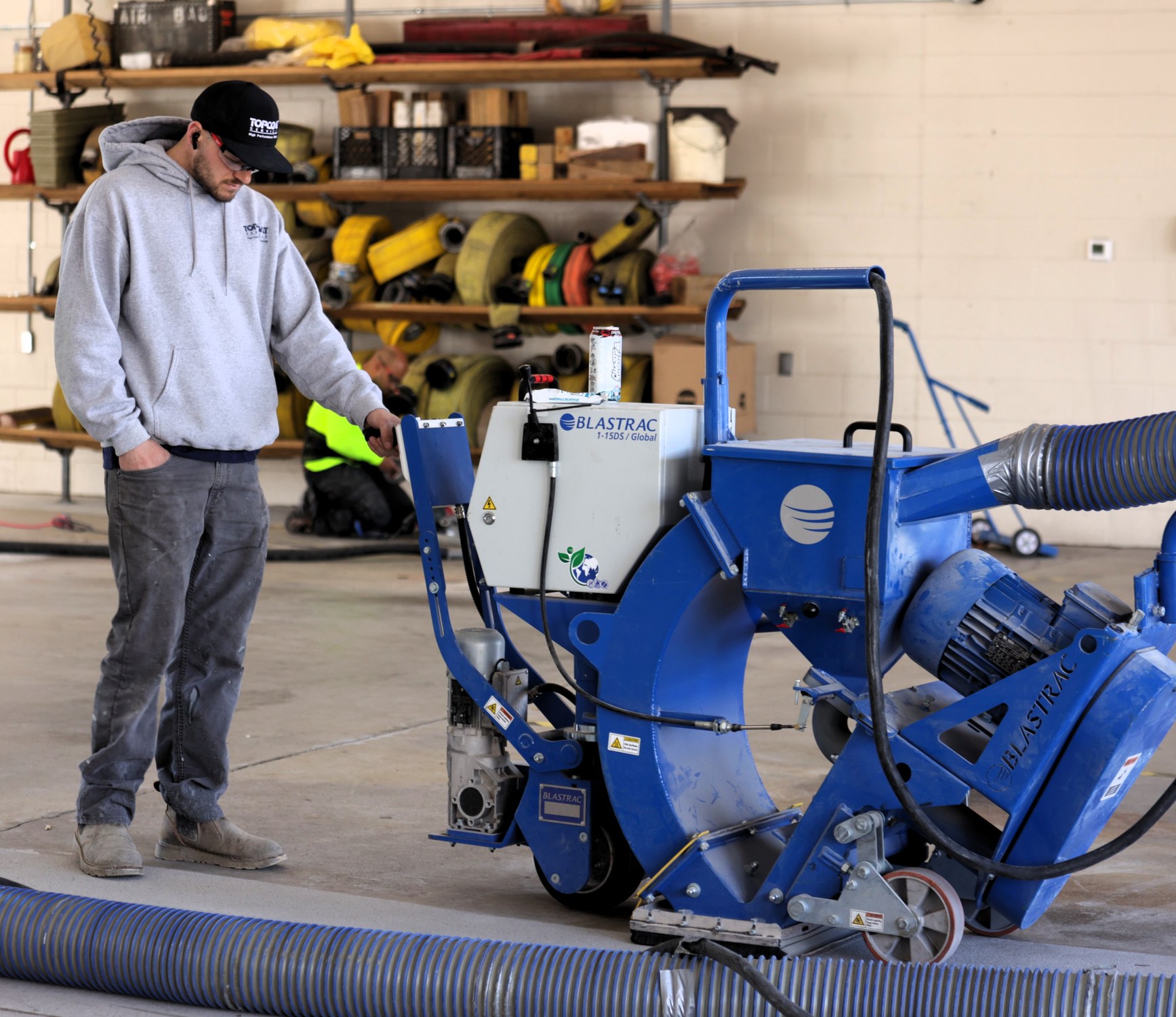
- Surface prep. Shot blasting or diamond grinding to the profile the manufacturer calls for. On a new slab, Peckham puts basic prep at $0.75 to $1.50 per sq ft added; on an old slab with coatings, sealers, paint, mastic, or carpet glue, full removal runs $2.50 to $6.00 per sq ft (Peckham Coatings). Our concrete repair and surface preparation page covers the methods.
- Repairs. Cracks, spalls, joints, and drains. These are site-specific and often only fully visible once grinding starts.
- Moisture testing and, if needed, mitigation. If the slab tests over the system’s limit, you’re paying for a mitigation primer or a moisture-tolerant system (see the Tulsa numbers above). More on this in how concrete moisture affects floor coatings.
- The system itself. Primer, body coats, broadcast aggregate, and topcoat, priced by total thickness.
- Details. Cove base, drains, transitions, line striping. Usually priced per linear foot or as separate items.
- Schedule. Overnight, weekend, and phased installs add 15–35% according to Peckham (Peckham Coatings).
A Sample Budget Using Public Bid Prices
To show how the pieces add up, here’s a 5,000 sq ft floor priced at the Tulsa 2024 unit prices for large footprints (City of Tulsa bid summary). This is arithmetic on published prices, not a Topcoat estimate, and your market will be different.
| Scenario | Line items | Total | Per sq ft |
|---|---|---|---|
| Clean, dry slab, light traffic | 30-mil roll coat ($7.00) | $35,000 | $7.00 |
| Same floor, thin old coating to remove | Removal ($1.50) + 30-mil roll coat ($7.00) | $42,500 | $8.50 |
| Forklift traffic, 1/8″ old coating | Removal ($3.50) + 3/16″ epoxy mortar ($9.80) | $66,500 | $13.30 |
| Same, but the slab tests wet | Removal ($3.50) + moisture-tolerant urethane cement build ($14.50) | $90,000 | $18.00 |
Same building, same square footage, and the number more than doubles depending on what’s under the old floor and what the moisture test says. That’s why a price over the phone is a guess, and why moisture testing belongs before you pick a system.
Massachusetts and Cape Cod Factors That Affect Price
We haven’t found a published Massachusetts price source we’d stand behind, so there’s no local number here. But these local factors affect quotes:
- Prevailing wage on public jobs. Schools, town buildings, and other public works in Massachusetts require prevailing wage rates set by the state’s Department of Labor Standards, and that applies to union and non-union contractors alike (Mass.gov). Expect public-project pricing to differ from private work.
- Winter installs. Epoxy cures slowly in cold slabs and air. Unheated warehouses, garages, and new buildings may need temporary heat or a cold-tolerant chemistry, which adds time and cost.
- Older slabs and moisture. Older mill buildings and slabs poured without a vapor barrier are common here. That pushes more jobs toward moisture mitigation. Our post on moisture mitigation for commercial flooring explains the options.
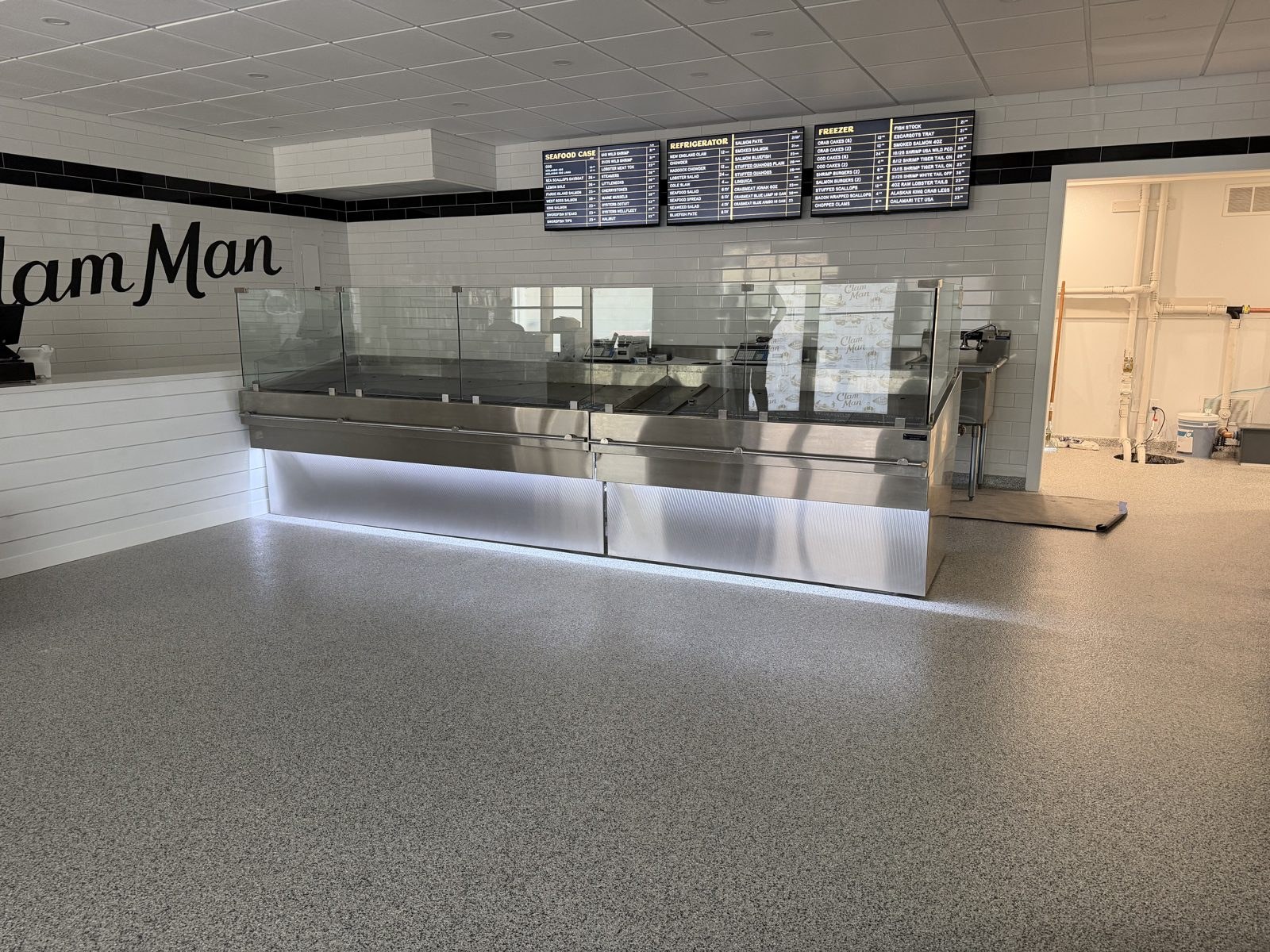
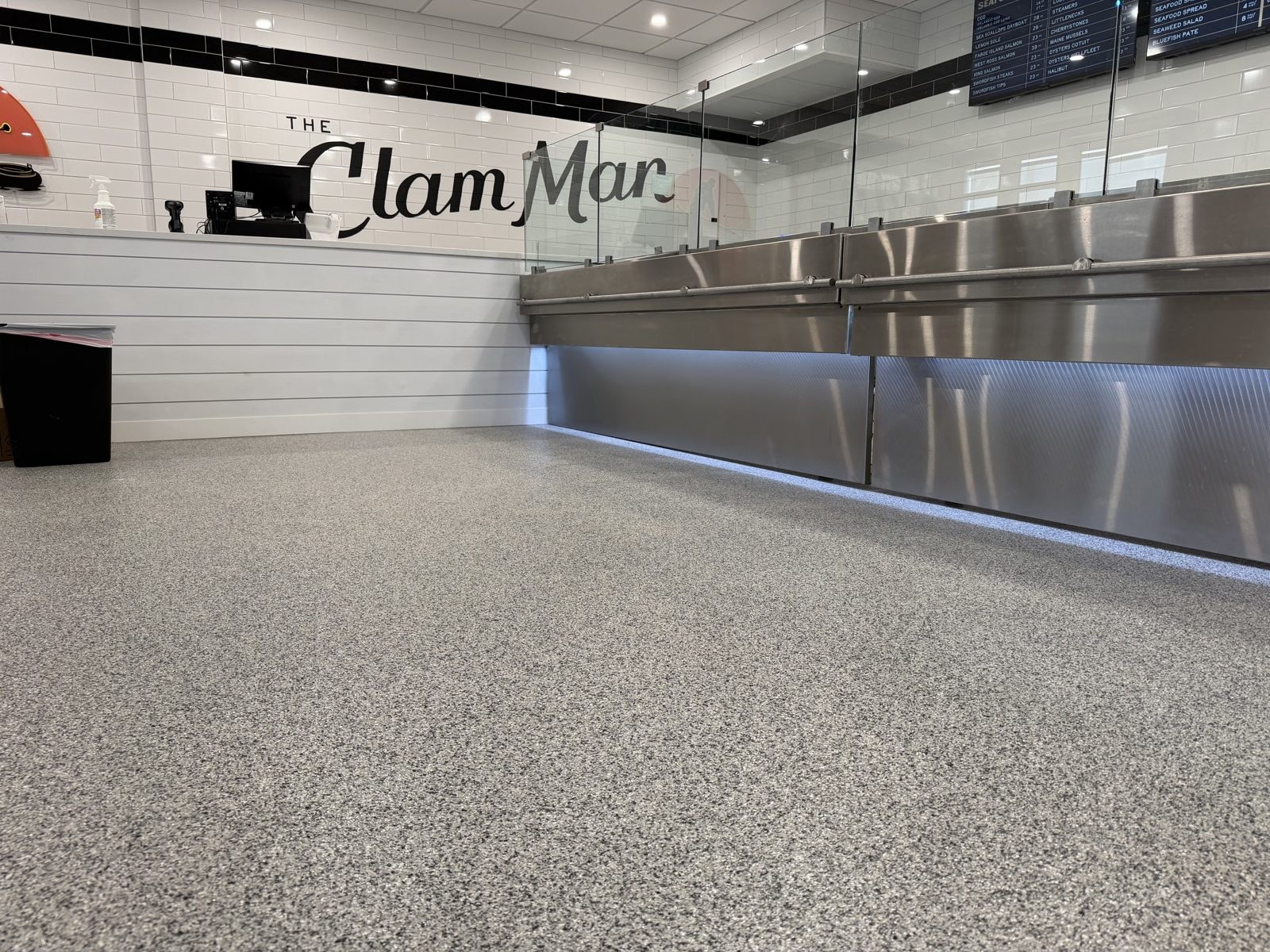
Here’s a recent Massachusetts job. At The Clam Man, a seafood market in Mashpee, we installed 1,825 square feet of 1/8″ flake epoxy with 225 linear feet of cove base. The work was completed in April 2026.
Epoxy Garage Floor Cost and Other Residential Floors
Topcoat does residential work too, so here’s the homeowner side. Angi puts professional epoxy at $2 to $12 per sq ft, with a 2026 national average project cost of $2,526 and most homeowners paying $1,650 to $3,494 (Angi). For a two-car garage of about 500 sq ft, Angi lists $1,500 to $6,000. HomeGuide puts epoxy at $4 to $10 per sq ft installed, with $1 to $5 for materials and $3 to $5 for labor, and $1,600 to $5,800 for a two-car garage (HomeGuide).
At home, the same rules apply: grind the slab, test basements for moisture, and be wary of thin water-based coatings. HomeGuide notes solid epoxy can last 10 to 20 years, while water-based epoxy may need a new coat every 3 to 5 years (HomeGuide). See our residential epoxy flooring page for more.
How to Compare Epoxy Flooring Quotes
Two quotes for “epoxy flooring” are rarely quoting the same floor. Before you compare the bottom lines, make sure every bid answers these:
- What’s the full system? Every coat, its thickness in mils, and the total build.
- How will the slab be prepped? Shot blasting, grinding, or both, and to what surface profile.
- Is old coating removal included? If so, priced how, and what happens if there’s more under it than expected?
- Was the slab tested for moisture, and what’s the plan if it fails? Ask for a priced alternate up front so it’s not a change order later.
- What repairs are included? A quantity or allowance for cracks and spalls, and how extra repairs are priced.
- What details are in? Cove base, drains, transitions, striping.
- What’s the schedule and return to service? Foot traffic, wheeled traffic, and chemical exposure can each have different cure times.
- What’s the warranty, and who backs it? Get it in writing.
A bid that’s far below the others usually skipped something on that list. We wrote more about that in the real cost of a commercial floor.
Ways to Lower Cost Without Cutting Corners
- Match the system to each zone. A dry storage room doesn’t need the same build as a forklift aisle or a wash bay. Specifying by area keeps you from paying for a heavy system everywhere.
- Bundle the work. Mobilization is largely fixed, so one visit for several areas usually beats several small jobs.
- Test early. A moisture test before you budget avoids a surprise mitigation cost mid-project.
- Recoat before it fails. Renewing a worn topcoat is far cheaper than grinding off a failed floor and starting over.
- Consider polished concrete where it fits. On a sound, dry slab without chemical exposure, polished concrete is worth pricing as an alternate.
Frequently Asked Questions
How much does epoxy flooring cost per square foot?
Published 2026 guides range from about $2 to $12 per sq ft for mostly residential work (Angi) and $3 to $14 for commercial work (Peckham Coatings). A 2024 public bid priced specified commercial systems at $7.00 to $17.50 per sq ft (City of Tulsa).
What does commercial epoxy flooring cost for a 5,000 sq ft floor?
At Tulsa’s 2024 large-footprint prices, a 30-mil roll coat on 5,000 sq ft works out to $35,000, and a 3/16″ epoxy mortar to $49,000, before removal, repairs, or moisture work (City of Tulsa). Your market and slab will change that.
How much does it cost to remove an old epoxy floor?
The Tulsa bid priced removal at $1.50 per sq ft for coatings 30 mils or thinner, $3.50 for 1/8″, and $6.00 for 1/4″ or more (City of Tulsa). Peckham puts full removal of old coatings, sealers, mastic, or glue at $2.50 to $6.00 per sq ft (Peckham Coatings).
Why do small epoxy jobs cost more per square foot?
Setup, mobilization, and equipment cost about the same on a small job as a big one. Peckham cites a 30–50% per-sq-ft premium under 3,000 sq ft, and the Tulsa bid charged $1.20 to $1.50 more per sq ft on footprints of 2,000 sq ft or less.
How much does an epoxy garage floor cost?
Angi lists $1,500 to $6,000 for a 500 sq ft two-car garage, and HomeGuide lists $1,600 to $5,800 (Angi, HomeGuide).
Get a Real Number for Your Floor
Published ranges are good for a first budget. A real number takes a site visit and a moisture test. Topcoat Services USA is a commercial and industrial flooring contractor based in Hyannis, MA, serving Cape Cod, Boston, and the rest of our service area across New England. We handle epoxy flooring, industrial flooring, urethane cement, polished concrete, and the surface prep that goes under all of them. For more on system choices, see our commercial epoxy flooring guide and concrete floor coating guide.
Tell us the facility, square footage, current floor, and schedule, and we’ll walk it and give you a quote built on your actual slab. Request a quote from Topcoat.
With over 12 years of work experience in various fields, I am a versatile and adaptable manager at Topcoat Services USA LLC, a leading provider of polished concrete and epoxy flooring solutions. I have a strong background in logistics, having served as a logistics specialist in the United States Marine Corps for four and a half years. I also have a passion for culinary arts, and I worked as a sous chef at Crafted Hospitality, a renowned restaurant group, for two and a half years. At Topcoat Services USA LLC, I leverage my skills in epoxy flooring, project estimation, and logistics to deliver high-quality and cost-effective projects for our clients. I enjoy working with a diverse and collaborative team of professionals, and I am always eager to learn new techniques and technologies in the flooring industry. My mission is to create durable, beautiful, and sustainable floors that meet the needs and expectations of our customers.